
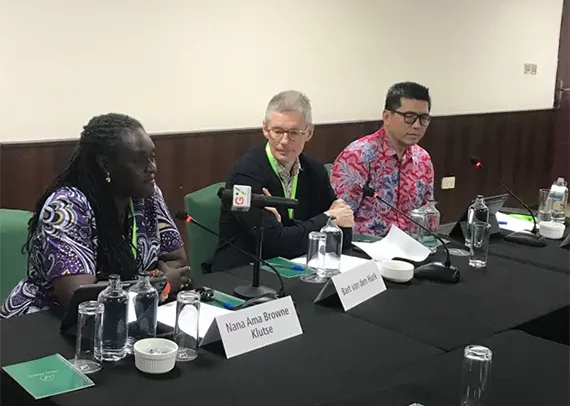
Prof. Nana Ama Browne Klutse (R), Bart van den Hurk (M) and Chow Winston addressing the press
Chief Executive Officer of Environmental Protection Authority (EPA), Prof. Nana Ama Browne Klutse, has stated that the African region is particularly vulnerable to the impacts of climate change—such as droughts, floods, and rising temperatures, hence the need for substantial support to adapt and mitigate these effects.
Speaking to journalists at the Intergovernmental Panel Climate Change (IPCC) Expert Meeting on Methodologies, Metrics, and Indicators for Assessing Climate Change Impacts and Adaptation, Prof. Klutse stated that the minimal interest and action by African leaders regarding climate change is significantly hindering the continent’s growth and development.
She emphasised that addressing climate change effectively could unlock opportunities for green technologies, sustainable agriculture, and renewable energy sources, ultimately leading to enhanced economic stability and growth in Africa.
Prof. Klutse opined that leaders in Africa need to be aware of and abreast with the changes that are occurring, as well as put measures in place, including updating policies and investing in the capacity to update their reports and do scientific publications.
“We have a local impact, and some countries do not have information. I mean adequate information, in terms of data and scientific reports of the happenings in the area. This affects decisions, because we need to have information all around the world, including where we come from in Africa, but we sometimes see that there’s minimal interest or limited interest in this area.
“This is what affects us. Affect us every day, and we African leaders must be interested in pursuing scientific knowledge, even local knowledge in the area, so that we can make informed decisions to sit at international meetings,” she said.
Co-Chair of IPCC Working Group II, Chow Winston, on the other hand, mentioned that Africa’s scientific community is rapidly growing and has valuable local knowledge to contribute to climate assessments.
“Having worked with many prominent African scientists over six assessment cycles, I’m impressed by the rapid development of scientific capacity in Africa. Our current assessment reflects the importance of local and scientific knowledge from Africa.
“We’re happy to increase African-based scientists in our working group to capture climate impacts, reduce vulnerability, and enhance adaptation in African cities and regions. This initiative will bear fruit in developing scientific capacity,” he stressed.
Minister of State in charge of Climate Change and Sustainability, Seidu Issifu, on his part, noted that while assessing adaptation progress lags behind the assessment of climate change impacts, Ghana is committed to climate action and welcomes the Global Goal on Adaptation (GGA) framework.
“In Ghana, we are taking concrete steps to address climate change. Our intended Climate Change and Sustainability Hub, led by my office, will help to strengthen district systems for locally led adaptation, improve climate data capture, and deliver prioritised climate action,” he added.
IPCC Co-chair of Working Group II, Bart van den Hurk, said the meeting which brings together approximately 75 experts from around the world, seeks to focus on how to stimulate discussions and provide relevant evidence on approaches, methodologies, metrics, and indicators for assessing climate change impacts and adaptation among other guidelines.
BY Prince Fiifi Yorke