
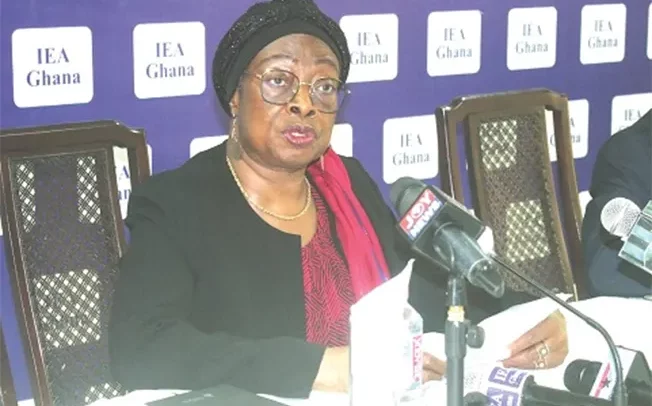
Former Chief Justice, Sophia Akuffo
The Institute of Economic Affairs (IEA) has called for full state ownership of the country’s natural resources following recent concerns over new tax reductions and the ratification of the Ewoyaa Lithium Mining Lease.
Responding to the passage of the Minerals and Mining Royalty Regulations, 2025, and the reduction of the Growth and Sustainability Levy (GSL) from 3% to 1%, Distinguished Fellow of the IEA and former Chief Justice, Sophia Akuffo, said the ongoing debate should focus on a more fundamental issue.
“There is a more fundamental issue beyond this current debate and discussion: who owns and controls Ghana’s natural and mineral resources, and in whose interest are they managed?” Madam Akuffo quizzed.
She also described Parliament’s approval of the Ewoyaa Lithium Mining Lease, ratified on March 19, 2026, which grants Barari DV Ltd the right to mine lithium in the Ewoyaa area for 15 years as inconsistent with the country’s long-term interests.
“Ghana must have full ownership of its natural and mineral resources and must exercise this ownership right by engaging private sector local and foreign expertise strictly through service contracts that preserve national control and maximise benefits for the country’s industrial transformation.
“The arrangement is outdated and we find it even more troubling that in 2026 Ghana is still entering into and ratifying a new mining agreement under the same royalties arrangement. The country must move away from traditional royalty-based systems,” she stated.
On the new royalty regulations, the IEA questioned the decision to cap rates under the sliding-scale regime, warning that it could limit the country’s ability to benefit from high global commodity prices.
According to her, capping rates could deny the country potential windfall gains while rejecting claims that the regulations could lead to massive job losses, describing such projections as “exaggerated, speculative, and not grounded in empirical evidence.”
The IEA further noted that the reduction of the Growth and Sustainability Levy undermines efforts to maximise revenue from the sector, warning that such policy inconsistencies weaken national benefits.
“Why did Government increase royalties only to simultaneously dilute that gain through tax concessions. How exactly does a 15-year lithium lease with virtually zero actual state participation uphold the principles of greater sovereignty?” she quizzed.
The IEA emphasised that true economic transformation depends on state control of resources, arguing that ownership enables value addition, job creation, and increased foreign exchange, adding that global trends show a shift toward such models.
She noted that Ghana’s repeated reliance on international bailouts despite its resource wealth highlights the need for reform and, therefore, called for urgent action to leverage the country’s natural and mineral resources for development.
“The country must adopt a new approach to resource governance. We must maximise benefits from our natural resources and leverage it for the country’s industrial transformation,” she added.
By Ebenezer K. Amponsah