
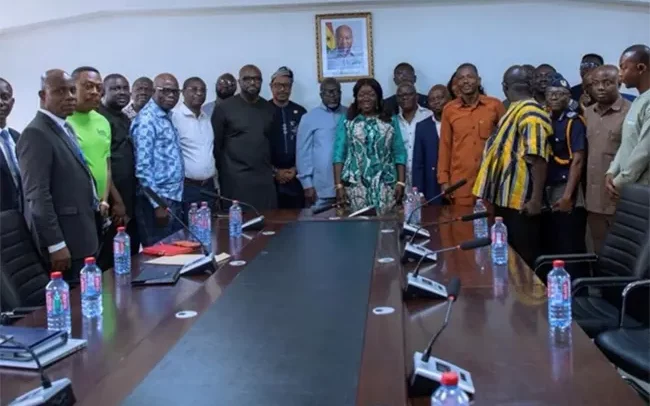
Elizabeth Ofosu-Adjare with stakeholders at the meeting
The Minister for Trade, Agribusiness and Industry, Elizabeth Ofosu-Adjare, has called for strict compliance with government ban on raw rubber exports as part of efforts to strengthen local processing and protect the nation’s rubber industry from collapse.
The Minister made the call during a stakeholder engagement involving rubber farmers, processors, industry associations and officials from the Customs Division of the Ghana Revenue Authority (GRA) and the Tree Crops Development Authority.
Discussions focused on raw rubber pricing, supply chain challenges and policy measures aimed at supporting domestic processing and industrial growth.
Mrs. Ofosu-Adjare reaffirmed government’s commitment to building an economy where raw materials are processed locally before export.
“I urged full compliance with the ban on raw rubber exports and assured industry players of my ministry’s collaboration with relevant agencies to remove bottlenecks, protect businesses, and strengthen Ghana’s rubber value chain for the benefit of all,” she stated.
She explained that the government’s industrialisation agenda sought to retain more value from the nation’s agricultural commodities through local manufacturing and value addition.
Commissioner-General of the Ghana Revenue Authority, Anthony Kwasi Sarpong, also called for stronger collaboration among stakeholders to safeguard investments and improve the competitiveness of the nation’s rubber sector.
The engagement forms part of broader efforts by government to expand local manufacturing capacity, reduce dependence on raw commodity exports and increase export earnings from processed goods.
Government has intensified value-addition policies across the agribusiness sector as policymakers seek to shift the economy away from exporting raw materials toward domestic processing and finished products.
Local rubber processors, however, insist the industry requires more decisive action to survive.
The Rubber Processors Association of Ghana is pushing for a complete ban on raw rubber exports, arguing that processing factories are being starved of raw materials despite significant investments in processing infrastructure.
Industry players say unregulated exports continue to undermine government’s stated policy direction and threaten jobs within the sector.
According to processors, more than 30 percent of the workforce in the industry has been laid off since the beginning of 2025 due to inadequate raw material supply.
They argue that the situation contradicts the government’s job-creation agenda under the proposed 24-Hour Economy policy.
Government first announced plans to restrict raw rubber exports during the presentation of the 2026 Budget Statement by Finance Minister, Cassiel Ato Forson.
The policy was intended to secure sustainable raw material supply for domestic processing factories and support the development of the local rubber value chain.
However, the Chief Executive Officer of the Tree Crops Development Authority, Andy Okrah, clarified that the current policy represented a restriction rather than an outright ban.
He said the authority remained ready to fully enforce a total ban should government officially announce one.
Secretary of the Rubber Processors Association of Ghana, Perry Acheampong, warned that several processing companies could collapse within months if urgent measures were not taken.
According to him, many firms are struggling to repay loans used to establish factories because they lack adequate raw rubber supplies to operate profitably.
Mr Acheampong disclosed that although Ghana currently has installed processing capacity exceeding 170,000 tonnes annually, national raw rubber production stood at only about 110,000 tonnes in 2025, leaving local factories heavily under-supplied.
By Ernest Kofi Adu