
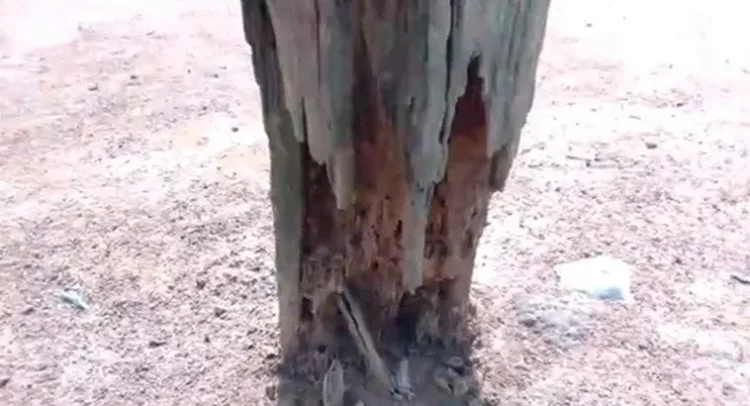
One of the termites-infested electricity poles
Residents of Soko in the Afigya Kwabre North District of the Ashanti Region have appealed to government agencies and the district assembly to urgently intervene in the numerous challenges confronting the community before disaster strikes.
The residents say their lives are constantly at risk due to several electricity poles that have been destroyed by termites and are on the verge of collapsing.
According to them, some of the affected poles are located in busy parts of the community, raising fears that they could fall and cause deaths or serious injuries if immediate action is not taken.
They further disclosed that the damaged poles have disrupted street lighting in parts of the community, especially around the new site area, making movement at night difficult for residents.
The situation, they said, has created security concerns and exposed motorists, traders and schoolchildren to danger, as some roads have become extremely dark during the night.
Aside from the electricity problem, residents also complained about the poor state of infrastructure at the local school.
They revealed that due to inadequate classrooms and deteriorating structures, authorities at the school have been compelled to merge classes, leading to severe congestion in the classrooms.
Teachers in the area say the overcrowding is affecting effective teaching and learning, since pupils are unable to concentrate properly during lessons.
Residents also lamented the persistent water crisis in the community, noting that many families struggle daily to access water for household activities.
According to them, women and children are the worst affected, as they are forced to walk long distances in search of water.
Speaking to the media, the Committee Chairman, Nana Yaw, indicated that repeated complaints had been lodged with the Afigya Kwabre North District Assembly, the Electricity Company of Ghana (ECG) and the Ghana Education Service (GES), but the concerns had not received the needed attention.
He appealed to the authorities to act swiftly to address the challenges, to prevent any unfortunate incident in the community.
FROM David Afum, Soko