
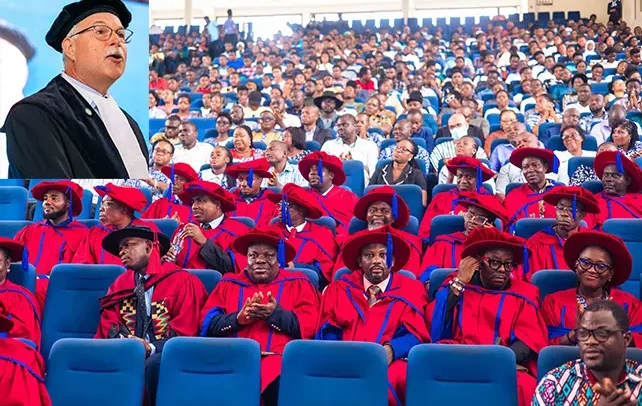
Management and staff of HTU at the event. INSET: Prof Dr. Ron S.J. Tuninga
Technical universities in Ghana must urgently reform their academic programmes, research priorities and industry partnerships to remain relevant in the age of Artificial Intelligence (AI), Rector of Wittenborg University of Applied Sciences, Prof. Dr. Ron S.J. Tuninga, has stated.
Speaking at the Seventh Vice-Chancellor’s Distinguished Lecture at Ho Technical University (HTU), Prof. Tuninga warned that rapid advances in AI, machine learning, robotics, blockchain technology, cybersecurity and quantum computing were transforming industries and redefining workforce demands globally.
Delivering a lecture on the theme, “Business Practice Education and Research in the Era of AI: Implications for Technical Universities in Ghana,” he said institutions of higher learning could no longer rely on traditional teaching models if they hoped to remain competitive.
“Technical universities must reposition themselves to prepare graduates for the realities of a rapidly changing digital economy,” he stressed.
According to him, AI is increasingly automating routine tasks, making continuous reskilling, adaptability and collaboration between humans and intelligent technologies essential for future employment.
He noted that AI-driven systems are already improving efficiency and decision-making in sectors such as finance, healthcare and manufacturing, creating new opportunities for innovation and entrepreneurship.
However, Prof. Tuninga cautioned that African countries face challenges including inadequate digital infrastructure, shortages of skilled professionals, weak research ecosystems and concerns over data governance and privacy.
He also highlighted the limited representation of African languages in AI systems and called for greater investment in locally developed datasets and indigenous AI solutions.
To address these challenges, he urged technical universities to review their curricula and integrate AI, machine learning and data analytics into both technical and business programmes while placing greater emphasis on ethics, critical thinking, creativity and problem-solving.
“The focus should shift from memorisation to judgement and innovation,” he said.
Prof. Tuninga further called for stronger collaboration between universities and industry to ensure graduates acquire practical skills that meet evolving labour market needs. He also encouraged institutions to expand lifelong learning opportunities through flexible programmes aimed at helping professionals upgrade their skills.
The Vice-Chancellor of Ho Technical University, Prof. Ben Q. Honyenuga, described the lecture theme as timely, noting that AI is reshaping education, research and business operations worldwide.
He said institutions must embrace emerging technologies to remain competitive, and reaffirmed HTU’s commitment to integrating AI and related technologies into teaching, research and industry engagement.
“As a technical university committed to career-focused education, applied research and innovation, we recognise both the opportunities and challenges that AI presents,” he stated.
The lecture attracted academics, researchers, students, industry leaders and policymakers, who examined the growing impact of artificial intelligence on education, business and research in Ghana and beyond.
FROM Daniel K. Orlando, Ho