
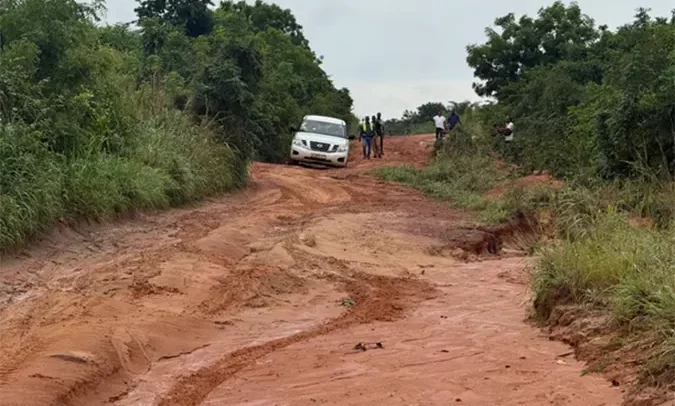
Photo of Ehi–Dzodze road project in the Volta Region
The Public Interest and Accountability Committee (PIAC), has called for stronger oversight and greater participation of Metropolitan, Municipal and District Assemblies (MMDAs) in the implementation of petroleum revenue-funded projects, following its inspection of projects in the Eastern, Volta and Oti regions.
The committee in its report issued on Wednesday, June 17, 2026 raised concerns over stalled abandoned health facilities, deteriorating infrastructure, non-functional water systems and discrepancies in reported road works of projects financed through the Annual Budget Funding Amount (ABFA).
The inspections conducted between May 24 and 29, 2026, forms part of PIAC’s constitutional mandate to independently monitor and evaluate the management and use of petroleum revenues under the Petroleum Revenue Management Act (PRMA).
The committee mentioned that the Ehi–Dzodze Road project in the Volta Region reported to have been surfaced with bitumen still remains untarred despite ABFA funding recorded.
“Community members informed the committee that only drainage works were undertaken, prompting calls for further clarification from the relevant authorities”.
In the Eastern Region, PIAC found that a three-unit classroom block with ancillary facilities at Kamalo D/A Junior High School had been completed but remained unused because of a bat infestation.
At Maame Krobo, a community-based mechanised solar-powered water system had been completed but was out of service due to a breakdown. Also sections of pothole patching works on the Maame Krobo Regional Boundary Road had already begun deteriorating, raising concerns about the quality and durability of the intervention.
The committee also mentioned that construction of the Agenda 111 hospital project at Tease had stalled and that the project was currently abandoned.
In the Oti Region, PIAC found that newly constructed 40-seater open market stalls in the Biakoye Constituency remained unoccupied. Traders told the committee they were unwilling to use the facility because the stalls were too small for their business activities.
It also identified delays were also noted at the two-storey Administration Block project in Jasikan, which was only about 60 per cent complete, forcing staff to operate from a partially completed bungalow temporarily converted into office space. The Agenda 111 hospital project at Jasikan was found to be at the foundation stage.
According to the report, at the Aflao Border, a police post funded through the ABFA was operational but lacked basic utilities and equipment stating the facility “currently lacks electricity, water supply, ventilation and adequate office equipment.”
The report further noted that despite some of the challenges the team observed, it mentioned several positive outcomes from petroleum revenue investments citing for example the completion of boreholes constructed at Kubease and Bodua in the Eastern region which were providing reliable water supply to the beneficiary communities.
“The construction of two senior staff bungalows at Jasikan was found to be about 98 per cent complete. While the project was near completion, the Committee identified a few defects requiring attention before final handover,” parts of the report revealed.
The committee also reported progress on the Afram Plains Agricultural Zone irrigation project at Konadu Enclaves.
In the Oti Region, the committee mentioned that spot improvement works on the Nkonya–Tepe–Toklosu Road were about 90 per cent complete and were already “providing improved access for motorists and residents.”
The committee also stated that the 1,000-metric tonne warehouse at Dzodze in the Volta Region, which became operational in November 2025, is currently being used by the National Buffer Stock Company.
While acknowledging the developmental benefits of ABFA-funded projects, PIAC maintained that concerns over maintenance, project quality, delayed completion and non –involvement of some stakeholders continue to affect projects.
By Ebenezer K. Amponsah