
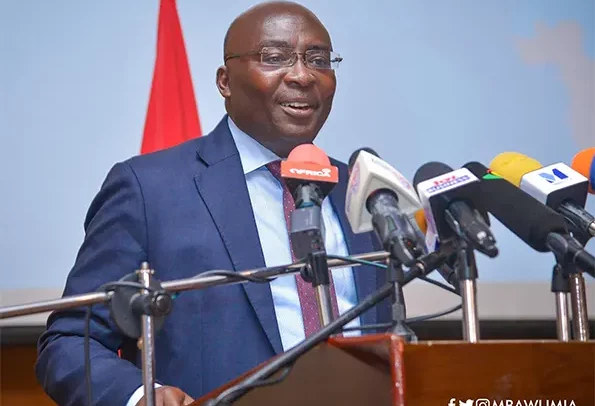
Dr. Mahamudu Bawumia
The opposition New Patriotic Party (NPP) flagbearer, Dr. Mahamudu Bawumia, has urged President John Dramani Mahama to withhold assent to the recently passed Tribunals Bill, 2026, warning that the legislation risks creating a “second justice system” and undermining public confidence in the country’s judiciary.
Addressing the nation on the controversial bill yesterday, Dr. Bawumia described the proposed reintroduction of tribunals into the nation’s judicial architecture as a matter with far-reaching implications for justice delivery, democratic governance and the country’s constitutional order.
He appealed directly to President Mahama not to sign the bill when it is presented to him, but rather suspend the process and allow broader national consultations on the matter.
“Mr. President, do not sign this Bill. Pause, and let the nation talk,” he said.
The former Vice President noted that Parliament passed the Tribunals Bill last week after waiving the mandatory one-day interval between the consideration stage and third reading, enabling the legislation to be approved on the same day.
According to him, objections raised by the Minority in Parliament and organised labour were overruled despite concerns about the implications of the bill.
Dr. Bawumia cited the position of the Trades Union Congress (TUC), which has called for the withdrawal of the bill, warning that in its current form it could become a tool for the weaponisation of justice delivery.
“This is not a partisan request,” he stressed, arguing that concerns about the bill extend beyond political divisions.
The NPP flagbearer also questioned the rationale behind Parliament’s decision, pointing to recommendations made by the Constitution Review Committee established by President Mahama.
According to him, the committee’s report, submitted last December, recommended the removal of Regional Tribunals from the Constitution on the grounds that the High Court has long assumed their responsibilities.
However, he observed that the report has yet to be published, while Parliament has proceeded to pass legislation that appears to move in the opposite direction.
“Before the nation has even read the report, Parliament has rushed through and legislated in the opposite direction. Mr. President, publish the report first,” he urged.
Dr. Bawumia further argued that the nation’s judicial challenges should be addressed by strengthening existing courts rather than establishing parallel structures.
While acknowledging concerns about congestion in the courts, he maintained that the solution lies in appointing more judges, expanding courtroom infrastructure and accelerating the digitisation of judicial processes.
“Our courts are congested, yes. But the answer to congested courts is to strengthen the courts: more judges, more courtrooms and digitised processes. It is not to build a second system of justice beside the one the Constitution already gives us,” he stated.
He also raised concerns that tribunal panels established under the proposed law could include individuals who are not legally trained but would nevertheless be empowered to adjudicate criminal matters.
Invoking Ghana’s historical experience with tribunals, Dr. Bawumia cautioned against reforms that could revive painful memories associated with the country’s past justice delivery systems.
“Ghanaians remember tribunals, and we remember what was done in their name,” he said.
The NPP leader further urged the government to exercise restraint, arguing that the National Democratic Congress (NDC), which commands a substantial majority in Parliament, should not rely solely on its numerical strength to enact legislation without broad consensus.
“Not everything that can be passed should be passed,” he said, adding that history would judge laws not by the number of votes they received but by whether they reflected the aspirations of a broad section of society.
Dr. Bawumia called for a comprehensive national engagement involving the Ghana Bar Association, other legal professional bodies, organised labour, civil society organisations, political parties and the Judiciary before any decision is taken on the future of the bill.
He stressed that justice belongs to Ghanaians rather than any government or political party, and argued that major changes to the country’s justice system should be built on national consensus.
Dr. Bawumia urged President Mahama to use constitutional mechanisms, including consultation through the Council of State under Articles 90 and 106 of the 1992 Constitution, to facilitate wider discussions on the bill rather than proceed with assent.
“The pen is in your hand. Use it, not to sign this Bill, but to write an invitation to the nation,” he said.
By Ernest Kofi Adu