
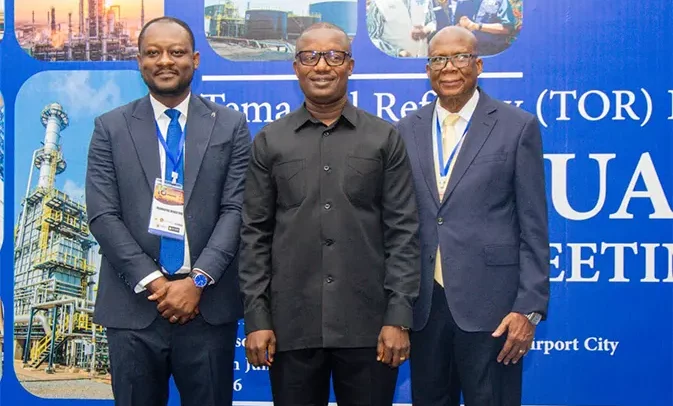
John Abdulai Jinapor (M), flanked by Edmond Kombat (L) and Nayon Bilijo
After years of debt, operational difficulties and repeated calls for privatisation, Tema Oil Refinery (TOR) has recorded its first profit in a decade under a new Board and management team.
“Losses escalated significantly in prior years, but in 2025, this trend reversed, resulting in a foreign exchange gain of approximately GHS 1.38 billion. As a result, the Company recorded: Operating profit: approximately GHS 1.25 billion Profit before tax: approximately GHS 1.42 billion Profit after tax: approximately GHS 1.09 billion. This represents the refinery’s first profit in over a decade, marking a historic financial turnaround” the report read.
Addressing stakeholders at the company’s 18th Annual General Meeting (AGM), in Accra, the Minister for Energy and Green Transition, John Abdulai Jinapor following the release of the refinery’s latest financial statements, commended the Board and Management of Tema Oil Refinery (TOR) for steering the state-owned refinery back to profitability.
“This achievement demonstrates what effective leadership, discipline and sound corporate governance can accomplish. Recording a profit after ten years is not only remarkable but also a strong indication that Tema Oil Refinery is on the path to sustainable recovery.”
The Minister noted that TOR’s performance reflects the commitment of the current leadership to restoring one of Ghana’s most strategic energy assets.
“The Board, under the leadership of Chairman Najon Bilijo, together with the Managing Director, Edmund Kombat, and the entire management team, deserve commendation for the work they have done so far. They have demonstrated that with the right leadership and accountability, TOR can once again become a commercially viable national asset.
“He has demonstrated beyond reasonable doubt that he is capable. Every objective person who takes a critical look at where TOR was, where he took the refinery and where he has brought it so far can only say 100 out of 100″he added.
The Minister stated that government remained committed to supporting reforms which will consolidate the refinery’s gains while positioning it to contribute more effectively to Ghana’s energy security and industrial development.
He explained that once the company becomes financially stronger, it will help strengthen Ghana’s petroleum value chain, improve energy resilience and reduce dependence on imported refined petroleum products.
The Managing Director of Tema Oil Refinery (TOR), Edmond Kombat, said the current management inherited a company saddled with severe financial, operational and governance challenges.
He said the management inherited a legacy debt portfolio of approximately USD517 million arising largely from statutory obligations, trade liabilities, and unresolved claims with receivables of approximately GHS 3 billion accrued under the ESLA framework, which did not translate into liquidity, as proceeds were largely applied to settling obligations directly with creditors coupled with unaudited financial statements from 2019 to 2024.
“Critical processing units including the Crude Distillation Unit and the Residue Fluid Catalytic Cracking Unit were either non-operational or significantly degraded due to prolonged inactivity and deferred maintenance.”he stated
According to Mr. Kombat, the management’s immediate priority was restoring operational capacity and rebuilding governance systems especially critical infrastructure that had also deteriorated after years of inactivity.
“I am pleased to report that turnaround maintenance on the Crude Distillation Unit has been successfully completed, leading to the resumption of refinery operations”.
He said in December 2025, the processing of approximately 600,000 barrels of crude oil provided clear evidence of renewed operational capacity and technical resilience.
This he explained represents the refinery’s first profit in over a decade, marking a historic financial turnaround adding that the cumulative losses recorded by the Company over the preceding nine years amounted to GHS6.08 billion.
“This single year’s profit does not erase that history, but it marks a decisive inflection point”. he noted
The Managing Director also highlighted what he described as one of the most significant governance reforms undertaken by the current management.
“By 30 April 2026, all six years of outstanding financial statements covering 2019 through to 2024 had been audited and finalised. The 2025 accounts were also completed and audited by 30 May 2026. In total, seven sets of audited financial statements were produced and presented in a single effort.”
“The year 2025 was a turning point. We cleared six years of audit arrears. We recorded the first profit in a decade. We reduced debt, cut payables and improved collections. We have consolidated. We have shown what is possible. Now we build. “he added
While welcoming the financial turnaround and progress made, Mr. Kombat however said that the journey to full recovery is a work in progress as the Board and Management remain firmly committed to strengthening operational efficiency, improving financial performance and ensuring long-term sustainability.
“The recovery of Tema Oil Refinery is not merely a corporate objective, it is a national imperative. A fully operational refinery will reduce Ghana’s foreign exchange expenditure on imported petroleum products, strengthen national energy security, promote local content development and enhance value addition to Ghana’s crude oil resources”.
For more than a decade, TOR struggled with mounting debts, intermittent shutdowns, inadequate working capital, obsolete infrastructure and low refining capacity, leaving the refinery unable to operate consistently to achieve its vision.
Analysts said the prolonged financial challenges fuelled continuous public debate over the future of the refinery, with some stakeholders proposing partial or outright privatisation to reduce losses and attract investment.
Over the years, energy experts have also pointed to poor corporate governance, political interference and accumulated liabilities as some of the major factors behind TOR’s decline.
Energy analysts believe the challenges significantly weakened TOR’s balance sheet and reduced its competitiveness within the downstream petroleum sector.
The Executive Director of the Africa Centre for Energy Policy (ACEP) and other researchers, in a publication titled “Plugging the Two-Decade Leak: Strategic Options for the Sustainability of Tema Oil Refinery, observed that TOR’s operational inefficiencies and financial constraints had affected its ability to function effectively as a refinery.
They argued that the long-term sustainability of Tema Oil Refinery depends on strong corporate governance, financial discipline and sustained capital investment to modernise operations.
The policy think tank has consistently maintained that while TOR remains a strategic national asset, its continued relevance depends on implementing reforms that improve efficiency and commercial performance.
In the light of this, energy expert have said that, the refinery’s financial turnaround in the 2025 financial year marks a significant departure from years of recurring losses and has largely credited it to reforms introduced by the current Board of Directors, chaired by Najon Bilijo, and the management team led by Managing Director Edmond Kombat.
According to the company, since assuming office, the Board and Management have implemented measures to strengthen corporate governance, improve financial controls, reduce operational costs, restructure debts and reposition the refinery for long-term sustainability.
These interventions, the Board said, have improved operational efficiency while rebuilding stakeholder confidence.
Analysts have said the 2025 audited financial statement shows that the refinery’s return to profitability demonstrates that “the strategic reforms undertaken by the Board and Management are beginning to yield measurable financial and operational results.
Some energy experts believe TOR’s return to profitability is expected to strengthen investor confidence and reinforce calls for continued reforms rather than wholesale divestiture.
Energy sector observers say the latest financial results validate longstanding recommendations by policy experts that governance reforms and prudent financial management, rather than outright sale of the company, offer a more sustainable pathway to reviving the refinery.
While acknowledging that significant challenges remain including recapitalisation, infrastructure modernisation and expanding refining capacity from the current 28,000 barrels per day towards the installed capacity of 45,000 barrels and eventually 60,000 barrels, the refinery’s improved financial performance is widely regarded as an important first step in restoring its position as Ghana’s premier petroleum refining company.
Industry analysts have also said sustaining the momentum will require continued investment, operational discipline and adherence to sound corporate governance principles to ensure that the refinery’s return to profitability becomes a permanent feature rather than a temporary recovery.
By Ebenezer K. Amponsah