
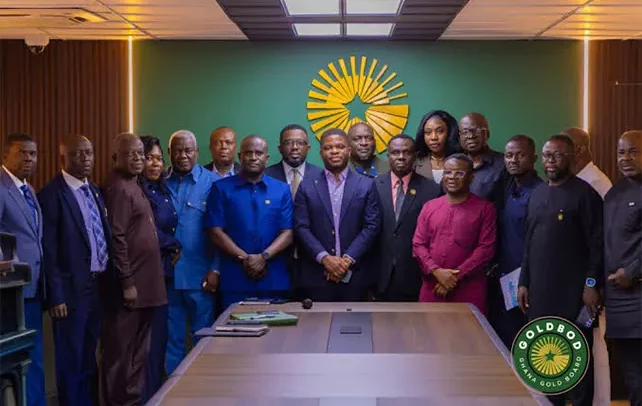
The MPs in a group picture with Sammy Gyamfi
Parliamentary Select Committee on Economy and Development has assessed the operations of Ghana Gold Board (GoldBod), following the institution’s US$16.11 billion in gold purchases and exports between January 2025 and May 2026.
The working visit forms part of Parliament’s oversight role to evaluate how GoldBod is contributing to foreign exchange mobilisation, reserve accumulation and value addition as government seeks to maximise benefits from Ghana’s gold resources.
Committee Chairman, Eric Afful, said the engagement was aimed at understanding GoldBod’s impact on the economy and its role in supporting Ghana’s recovery. “We want to assess how the Board is strengthening the gold value chain, improving foreign exchange inflows and ensuring Ghana captures greater value from its mineral wealth,” Mr. Afful stated.
Massive gains from small-scale sector
GoldBod Chief Executive Officer, Sammy Gyamfi, told the Committee that the Board purchased and exported 135.843 metric tonnes of gold valued at US$16.11 billion in the 17-month period. He said 135.221 metric tonnes, representing virtually the entire volume, came from the artisanal and small-scale mining sector.
Mr. Gyamfi attributed the performance to reforms that have formalised small-scale mining, reduced illegal trading and pushed more gold into official channels. “The reforms have significantly increased the volume of gold entering official marketing channels, enabling the state to capture more export revenue,” he said.
The GoldBod CEO added that the growth in official purchases has strengthened Ghana’s external position by increasing dollar inflows at a time government is working to stabilise the economy.
1,184 buyers licensed
GoldBod has also expanded regulation of the trading space. As of May 31, 2026, the Board had licensed 1,184 gold buyers. This comprises 2 aggregators, 67 self-financing aggregators, 736 Tier Two buyers and 379 Tier One buyers. Under the GoldBod framework, all licensed buyers must purchase gold exclusively from licensed miners before selling to the Board for export. Officials say the licensing system is part of measures to reduce smuggling, improve traceability and ensure export proceeds flow through official channels to strengthen reserves.
Traceability system and legal reforms
Mr. Gyamfi disclosed that GoldBod will procure a comprehensive gold traceability system by the end of August 2026. The system will track gold from the mine site through to export. He said it is expected to strengthen accountability, improve confidence in Ghana’s gold exports and help eliminate illegal trading and smuggling.
The GoldBod CEO also briefed the Committee on the ongoing review of the Ghana Gold Board Act, 2025, Act 1140, the Board’s licensing and funding model, partnerships with large-scale miners, and a new trading model aimed at improving efficiency and transparency.
Gold central to reserve accumulation target
GoldBod said its operations are directly linked to government’s Ghana Accelerated National Reserve Accumulation Programme (GANRAP), which seeks to build foreign reserves to 15 months of import cover by 2028. Ghana currently has about 5.7 months of cover. To meet the target, government estimates an average annual net reserve build-up of US$9.5 billion is required after debt servicing and other obligations.
Under GANRAP, authorities have set a weekly gold purchase target of 3.02 metric tonnes. Officials estimate achieving this could generate annual gross inflows of about US$25.3 billion.
Mr. Gyamfi noted that 2026 projections were based on gold at US$5,000 per ounce and weekly purchases of 2.5 metric tonnes. Although prices have since declined, bullion prices remain above 2025 levels, meaning Ghana is still expected to record higher gold export earnings this year.
He added that with small-scale mining continuing to outperform large-scale production, gold will remain a major pillar of Ghana’s foreign exchange earnings and economic recovery in 2026.
The Committee’s visit underscores Parliament’s growing focus on gold management as a key tool for reserve build-up, exchange rate stability and value retention from Ghana’s mineral resources.
A Daily Guide Report