
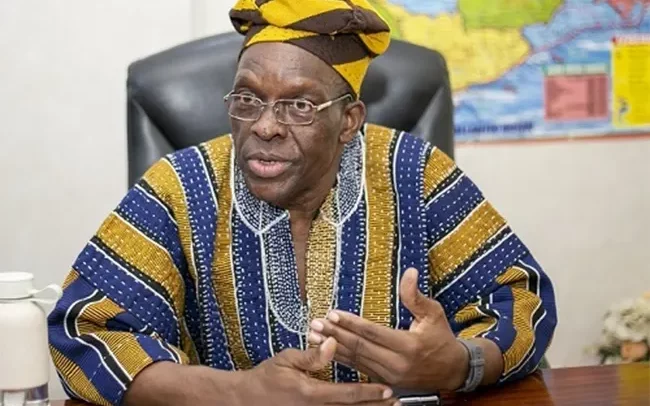
Alban Sumana Kingsford Bagbin
The Speaker of Parliament, Alban Sumana Kingsford Bagbin, has called for a permanent partnership between Parliament, academia and civil society organisations to strengthen evidence-based lawmaking, enhance public accountability and improve democratic governance in the country.
He said Parliament’s legislative and oversight functions would be more effective if they were consistently informed by independent research, policy analysis and the lived experiences of citizens, rather than relying solely on official government submissions.
Speaking at the launch of an information-sharing session between parliamentary committees on economic governance and public financial management, academia and civil society organisations, Mr. Bagbin said the initiative was intended to establish a structured platform for continuous dialogue, knowledge sharing and collaboration among the three groups.
He observed that while Parliament, universities and civil society organisations all contribute to national development, opportunities for sustained collaboration had been limited over the years.
According to him, the absence of such collaboration had meant that valuable research often failed to inform parliamentary deliberations, while the experiences of ordinary citizens were not always adequately reflected in public policy.
“We seek to nurture an enduring partnership in which rigorous research informs legislative decision-making, while civil society enriches parliamentary deliberations with practical experience,” he stated.
The Speaker stressed that Parliament had the constitutional responsibility of making laws, approving major public policies and holding the Executive accountable, but noted that these responsibilities could only be effectively discharged through access to credible evidence and independent expertise.
He therefore urged parliamentary committees to engage researchers and policy think tanks throughout the budget cycle, legislative scrutiny and oversight processes.
Mr. Bagbin described economic governance and public financial management as among Parliament’s most consequential responsibilities, explaining that decisions on taxation, borrowing, public expenditure and debt sustainability directly affected the welfare of citizens and the country’s economic future.
He cautioned that governments had a natural tendency to increase expenditure and said Parliament must remain vigilant in protecting the public purse.
“As Parliament, we only have to doze off for a second and the government goes on a shopping spree at the expense of the fundamentals of life,” he remarked, describing Parliament as the nation’s “guard dog” over public finances.
The Speaker said effective oversight required more than official reports and government submissions, insisting that Parliament needed independent research, objective analysis and informed public perspectives to evaluate whether government policies were delivering their intended outcomes.
He urged academic institutions and civil society organisations to continue producing objective, policy-relevant research that would strengthen parliamentary debates and improve decision-making.
Mr. Bagbin also announced plans to deepen citizen engagement by strengthening Parliament’s institutional mechanisms for public participation.
He highlighted initiatives such as the Open Parliament Plan, the electronic petitions platform, live broadcasting of parliamentary proceedings, Open Parliament Week and the establishment of the Citizens Bureau as measures designed to make Parliament more transparent, accessible and accountable.
He directed Parliament’s administrative departments to ensure the Citizens Bureau functions as the central repository of parliamentary information, enabling citizens, researchers and civil society organisations to access information on parliamentary proceedings more easily.
According to him, the Bureau should serve as a bridge between Parliament and the public by collecting, organising and making parliamentary information readily available while facilitating the flow of citizens’ concerns into legislative deliberations.
The Clerk to Parliament, Ebenezer Ahumah Djietror, said the information-sharing session marked an important milestone in Parliament’s efforts to deepen public participation and bridge the gap between research and policymaking.
He said the forum would enable Members of Parliament (MPs) to benefit from independent research and diverse perspectives as the House considered the 2026 Mid-Year Fiscal Policy Review, thereby promoting more informed decision-making in the national interest.
By Ernest Kofi Adu, Parliament House