
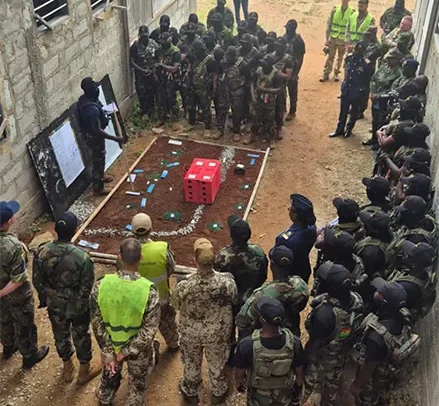
EU and Ghanaian security officials undergo a joint training to strengthen security response
For decades, the European Union (EU) was known in Ghana primarily as a trade and development partner. We invested in communities, supported civil society, financed infrastructure and worked with successive Ghanaian governments on development priorities. That relationship remains important. But the world has changed – and so has the EU.
European citizens increasingly expect Europe to do more to protect its interests and security. This does not mean abandoning development cooperation. It requires partnerships that are not based on a donor-beneficiary model, but on shared interests, shared responsibilities and mutual respect.
In Ghana, this evolution should come naturally. Europe and Ghana have much in common. We share a strong belief in democracy, multilateralism, rule of law and the peaceful resolution of disputes. Ghana’s democratic stability is not only an achievement to be applauded; it is an example for the entire West African region.
A peaceful and stable West Africa is good for Ghana, good for Europe and good for business. It facilitates trade and investment, protects vital maritime routes and creates the conditions in which people can travel, work and prosper. At a time when instability and violent extremism are spreading across parts of the Sahel, Ghana’s stability matters well beyond its borders.
This is why, in March this year, the European Union and Ghana signed a Security and Defence Partnership – the EU’s first such partnership with an African country. EU High Representative Kaja Kallas and Ghanaian Vice-President Naana Jane Opoku-Agyemang signed the agreement in Accra, marking a new chapter in the relationship between the EU, its 27 Member States, and Ghana.
So what does this partnership actually entail? Let us start with what it does not mean.
It does NOT mean foreign military bases in Ghana. It does not mean permanent European troops stationed here. And it certainly does not create any pathway towards NATO membership.
The partnership offers something much more practical: Ghana and Europe working together to address threats that neither can tackle alone.
First, it gives political direction to our shared security concerns. These range from the spread of violent extremism and terrorism from the Sahel to maritime security, organised crime, cyber threats and other forms of hybrid interference. The agreement also recognises that security today cannot be separated from environmental and climate pressures or conflict prevention.
Take illegal mining. Galamsey is rightly discussed primarily as an environmental, economic and public-health crisis. But it also has a security dimension, and deserves to be treated as a national security priority.
Second, the partnership gives strategic direction to the EU’s growing practical support for a more secure Ghana. With around 30 ongoing projects strengthening peace and security we combine cooperation with security and defence forces, and support for community resilience, particularly in the northern regions. EU interventions range from border management, to the prevention of violent extremism, dialogue and mediation, conflict prevention, and fighting transnational organised crime.
The European Peace Facility provides over €50 million in non-lethal military equipment, including vehicles, surveillance and counter-drone capabilities, electronic warfare systems and explosive ordnance disposal equipment.
Equipment is only part of the story. European partners also support training and capacity-building within the Ghana Armed Forces, including through the EU Security and Defence Initiative in the Gulf of Guinea.
The objective is not to fight Ghana’s battles for her. It is to strengthen Ghana’s ability to keep Ghanaians safe. EU Member States are actively involved. Germany and France provide training and capacity-building, while Italian, Spanish and Portuguese vessels navigate the Gulf of Guinea. Each country brings its own specialised expertise: the Netherlands on countering illicit trafficking, Denmark on maritime security, and Austria on K-9, to name just a few examples.
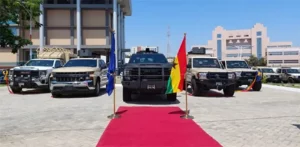
In 2023, EU delivered 105 armoured vehicles to Ghana to bolster its security and defence
The instability spreading through the Sahel has reminded Ghanaians that insecurity does not respect borders. Cyber-attacks, disinformation, organised crime and maritime insecurity demonstrate that the threats of the 21st century are increasingly transnational.
Russia’s war against Ukraine has reminded Europeans that peace cannot be taken for granted, and that sovereignty and territorial integrity are not abstract principles. Now that Russia is losing the war, Europe is doubling down on partnerships with like-minded partners like Ghana who share a commitment to the principles embodied in the UN Charter, with respect for territorial integrity at the core.
The Security and Defence Partnership is not a departure from the EU-Ghana relationship. It is its logical next step. Development, trade, investment and security are not competing agendas. They reinforce one another.
The EU wants a prosperous Ghana. Ghana wants a prosperous Europe. Both need a peaceful and stable West Africa.
That is not a donor-beneficiary relationship. It is a partnership between two sides with something worth protecting – and a shared interest in protecting it together.
By Jonas Claes, Deputy Head of Delegation, Chargé d’Affaires