
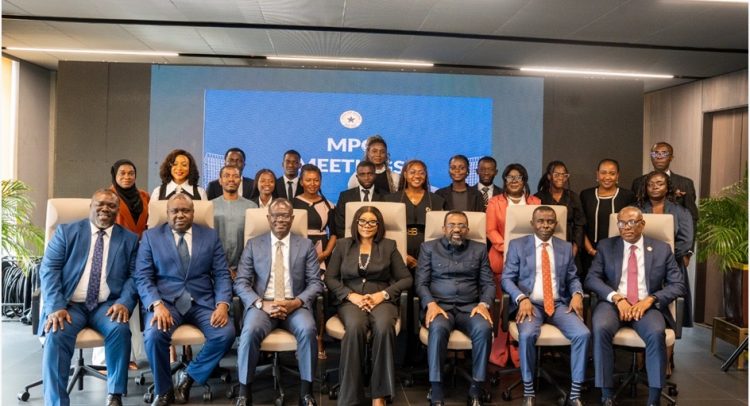
Some students from the Department of Economics at the University of Ghana on Wednesday participated in the Bank of Ghana’s (BoG’s) 131st Monetary Policy Committee meetings(MPC) as part of efforts to deepen their understanding of monetary policy decisions as well as bridge the gap between economic theory and policy formulation.
According to the Bank of Ghana, the new initiative dubbed ‘Monetary Policy Committee Educational Observership Programme (MPC-EOP)’ forms part of the bank’s commitment to expose students of economics and finance professionals to the rigorous analytical processes that informs decisions on the Monetary policy Rate and communication process.
The programme is also expected to help students and the general public move beyond learning monetary policy solely through theory by allowing them to observe how economic evidence is assembled, analysed and discussed before the committee reaches a policy decision.
The students were first introduced to the country’s policy framework, the role of the Monetary Policy Committee beforeobserving the technical presentations that form the foundation of the committee’s deliberations.
Officials of Bank of Ghana also presented detailed assessments of Ghana’s macroeconomic conditions, inflation trends, global economic developments, the external sector, financial markets, agriculture among others.
The presentations demonstrated the depth of analysis that underpins monetary policy decisions and highlighted the wide range of economic indicators considered by the committee.
One of the students said that before participating in the programme, there had been a common misconception that the Governor alone decided the Monetary Policy Rate but said that assumption changed after observing the meetings.
“One misconception that has changed completely is the fact that every time we see the Governor on the news announcing the policy rate, we assumed he had made that decision on his own.What we have observed shows that the decision is the result of thorough analysis, careful discussion and contributions from many experts. It has given as an opportunity to practicalise what we are learning “
Speaking during the opening session of the 131st Monetary Policy Committee Meetings (MPC), Dr. Johnson Pandit Asiama described the initiative as an important step in the Bank’s commitment to transparency and public engagement.
“Monetary policy is most effective when it is understood, trusted, and supported by the public. Through this initiative, we seek to demystify the monetary policy process by providing students with practical exposure to the analytical work, technical discussions and communication processes that underpin the Committee’s decisions.”
“By opening aspects of that process to students, the Bank of Ghana is not only strengthening transparency, but also inspiring the next generation of economists to better understand the institution responsible for maintaining price stability and supporting the country’s economic development”.he added
Dr. Asiama said the programme forms part of the Bank’s broader efforts to strengthen policy credibility while building stronger linkages between academia and public policy institutions.
Following the MPC meetings Governor engaged the students and faculty members in a special post-MPC discussion toexplain the policy decision in simple, practical terms, providing a unique perspective on how central bank communication translates complex economic decisions in a manner that is easily understood by the public.
Faculty members accompanying the students welcomed the initiative and described it as an important bridge between academic learning and public policy practice as it providedstudents with practical insights that complement classroom instruction while exposing them to the analytical discipline required in central banking.
The participants who commended the Bank of Ghana for the initiative appealed to the central bank to expand the programme to other tertiary Institutions across the country to promote economic literacy, strengthen understanding of monetary policy issues among potential economists, researchers among others.
By Ebenezer K. Amponsah