

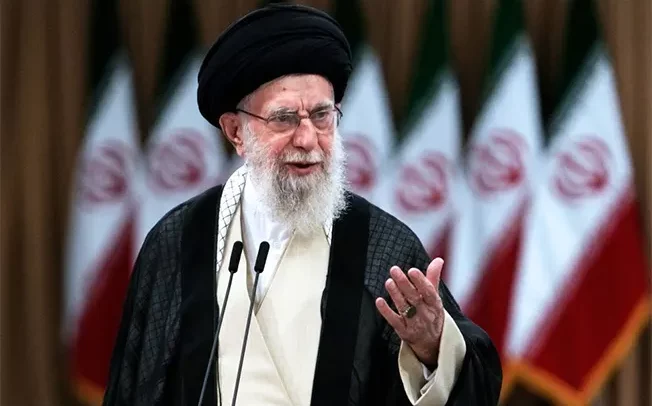
Ayatollah Ali Khamenei
War has erupted in the Middle East following the confirmed assassination of Iran’s Supreme Leader, Ayatollah Ali Khamenei, in a coordinated strike by the United States and Israel.
The attack, which also killed several senior Iranian security officials, including the Police Intelligence Chief, has sent shockwaves through the region and is expected to trigger a sharp rise in global crude oil prices.
The assassination occurred on February 28, 2026, prompting the immediate formation of a provisional leadership council in Tehran.
The council comprises President Masoud Pezeshkian, Head of the Judiciary Gholam-Hossein Mohseni-Eje’i, and Alireza Arafi of the Guardian Council.
An Assembly of Experts, consisting of 88 senior clerics, will convene to elect a new Supreme Leader. Among the potential successors is Hassan Khomeini, grandson of the Islamic Republic’s founder, Ruhollah Khomeini, who is considered a more conciliatory figure.
Initial reports of Khamenei’s death were denied by Iranian media, which claimed he remained in charge, a reaction many observers dismissed as typical wartime misinformation.
The first confirmation came indirectly when Israeli Prime Minister Benjamin Netanyahu suggested that the Iranian spiritual leader “was gone.”
U.S. President Donald Trump reinforced the claim, stating publicly that the “world’s evil man” had been killed using advanced U.S. technology from which the Supreme Leader could not escape.
Iran later confirmed the attack, acknowledging that the compound housing Khamenei had been targeted and several family members killed.
The Iranian Revolutionary Guards have responded with missile strikes targeting American bases across the Middle East.
Countries hosting U.S. installations, including Bahrain, Qatar, and the United Arab Emirates, have come under missile fire, raising concerns over regional security.
Israel has closed its airports and advised citizens to remain indoors so as Ghana. Despite intercepting many incoming missiles, some areas were hit, resulting in injuries and at least one reported death in Tel Aviv.
The ongoing assaults have disrupted flight operations globally, with Dubai’s airport, the world’s busiest, among the affected hubs.
President Trump has warned Iran that further retaliation would trigger an unprecedented U.S. response, signaling a potential regime change and the destruction of Iran’s nuclear capabilities.
Tehran, however, has shown no signs of backing down, escalating hostilities across the Middle East. The United Nations convened an emergency session to address the conflict, which highlights the far-reaching global implications of the crisis.
The attacks mark a dramatic escalation in tensions that had been simmering since America and Israel targeted Iranian nuclear facilities in a 12-day war earlier this year.
Ghana like others around the globe would suffer oil price hikes the knock-down effects translating into increased costs for consumers and businesses.
Recent negotiations between Iran and Qatar over the country’s nuclear programme had failed to yield progress, prompting the U.S. to take decisive action.
The conflict is already having a ripple effect on global markets. Oil prices are surging, while uncertainty threatens supply chains, trade, and currency stability, including potential impacts on the Ghanaian cedi and domestic prices for goods and services.
Analysts have warned that prolonged hostilities could further destabilize global economies and complicate budget projections worldwide.
A Daily Guide Report