

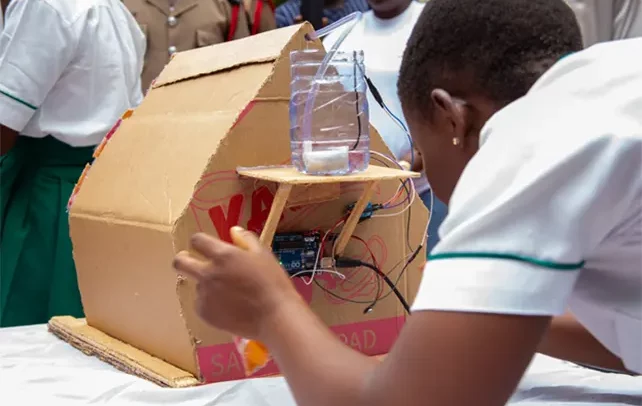
A student experimenting with her STEM creation
Telecel Ghana Foundation has begun the third cohort of its Digitech Academy, an after-school digital skills programme aimed at strengthening Science, Technology, Engineering and Mathematics (STEM) education and addressing persistent digital access gaps among young learners.
The latest cohort, which runs from January to March 2026, is being implemented across five districts in five regions: South Dayi in the Volta Region, Mfantsiman in the Central Region, Jirapa in the Upper West Region, Goaso in the Ahafo Region, and Bolgatanga in the Upper East Region.
The programme will engage students from 19 schools and is expected to reach up to 500 learners, building on the momentum of the two previous cohorts.
The Digitech Academy is delivered under the Telecel Ghana Foundation’s Connected Learning pillar in partnership with the Ghana Education Service (GES) and the Ghana STEM Centre. It targets upper primary and junior secondary school students and runs as a 12-week after-school programme aligned with Ghana’s national academic calendar.
“This third cohort reflects our belief that access to digital skills should not depend on location or socioeconomic background. We are expanding the Digitech Academy into more districts, particularly outside major urban centres to give young learners practical, future-ready skills to compete with their peers globally and in support of Ghana’s broader digital transformation agenda,” said Komla Buami, External Affairs Director at Telecel Ghana.
The curriculum is structured to complement the GES ICT syllabus and covers a range of foundational and applied STEM topics. Students receive training in electronics and programming, where they learn to build simple circuits, write basic code and understand the basic principles of robotics, resulting in the design and programming of their self-built functional robots.
Telecel DigiTech Academy holds in-person sessions weekly with implementation support provided by local partners, Asustem Robotics and the Mingo Foundation, who facilitate hands-on instruction and project-based learning.
According to GES, STEM initiatives like the Telecel Digitech Academy play a critical role in supplementing classroom learning and shaping Ghana’s future.
During the pilot launch of DigiTech Academy in Ho, a representative from the office of the Director of the National STEMCentre, Olivia Serwaa Opare, said the programme is shaping Ghana’s future positively.
“To truly empower our youth and prepare them for a competitive global market, we must ensure that they do not just use technology but understand and master it. STEM education is no longer optional but essential for the country’s growth,” she said.
A key feature of the programme is its emphasis on gender inclusion. Seventy percent of training slots are reserved for female students, with the remaining 30 percent allocated to males, as part of a deliberate strategy to address long-standing gender disparities in STEM participation.
A pupil of the Peki Adzokoe D.A. Junior High School, Francisca, and part of the third cohort of the Telecel DigiTech Academy said, “I’m excited about this life-changing learning experience because I want to learn how to code and create my own game.”
The Digitech Academy has expanded significantly since its pilot phase, which began with just 50 students. Cohort one concluded with 700 students from39 schools across six regions, while Cohort two reached 1,041 students from 47 schools in 10 regions. Over the course of the programme,students are assessed through practical projects, with certificates awarded to all participants and medals presented to top performers.
Telecel Ghana Foundation said the initiative reflects its long-term commitment to support youth development, digital literacy and educational outcomes in Ghana.
A Business Desk Report