
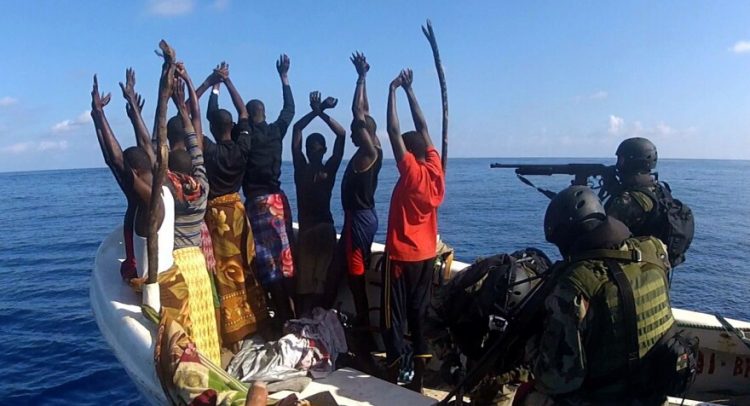
The Gulf of Guinea has never been so dangerous.
Discourses about maritime safety, when they do take place, are hardly attention-engaging, the subject regarded as mere abstracts to many.
Now that the reality of the dangers in the Gulf of Guinea has dawned upon us with the attack on 71 Ghanaian fishermen by pirates, we are talking.
Now we know that it is important that the Navy should be adequately equipped to discharge their mandate of protecting our territorial waters.
Now we appreciate the fact that just as there are highway robbers, so are there pirates now active on our territorial waters, and not on the pages of a fictional Long John Silver literature. Pirates respect no maritime borders and can operate on all waters if there are no effective inhibitions.
The attack on our fishermen did not take place close to home, but within our maritime residence so to speak.
It is instructive to note that a number of critical engagements on maritime security in the Gulf of Guinea have taken place, all of them to ostensibly shore up security within the territorial waters of this maritime space.
The Ghana Navy, for instance, hosted the 4th International Maritime Defence Exhibition and Conference (IMDEC) last year. Participants from over 70 countries discussed regional cooperation and how to fight piracy and ensuring a thriving blue economy.
Even before that, an ordinary session of the Assembly of Heads of State and Governments conferred on the safety of the Gulf of Guinea on August 5, 2024.
The foregone from the instances of maritime piracy, which have been recorded in the Gulf, point at the fact that the dangers persist.
It is important that countries within the Gulf of Guinea take the security within this maritime space more seriously than they have.
While we acknowledge the costly funding of security management on the high seas, we would hasten to add that alternatives be sought because the fallouts from not acting can only be imagined.
When the lives of ordinary fishermen are put at risk by pirates the way it unfolded a few days ago, folding our arms cannot be an acceptable option.
The Senya Bereku security incident is a wakeup call that we could not be more in the sight of pirates than now.
Until a regional maritime force is assembled to tackle piracy on the Gulf of Guinea more effectively, let us take the equipping our Navy more seriously in the context of other measures.
In his last year as President, the Nana Addo Dankwa Akufo-Addo government tabled a request for the acquisition of special speed boats for the Navy, but the then National Democratic Congress (NDC) Minority kicked against it. We hope that now they would reconsider their position in the light of the reality of the insecurity in the Gulf of Guinea.
It is also important to hold periodic seminars for our fishermen about piracy and the need to be security conscious. This way, they would understand that things are no longer the same in their occupation.
The Navy should also engage in occasional drills with selected fishermen, including chief fishermen.
With Nigeria seemingly making positive inroads against piracy on their territorial waters, pirates would seek places which present weak links where they can ply their unworthy occupation.