
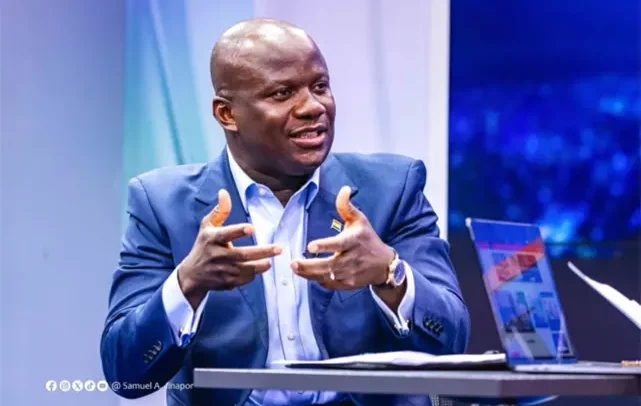
Samuel Abu Jinapor
Ghana has slipped in the latest ranking in the Global Mining Investment Attractiveness Index report, dropping to 53rd in 2025 from the 46th position recorded in 2024.
The latest ranking positions Ghana behind other African countries such as Côte d’Ivoire, the Democratic Republic of Congo, Namibia, Zambia, Tanzania, Morocco and Botswana, indicating a relative decline in the country’s attractiveness to mining investors.
More concerning is the fact that only 68 countries were assessed in 2025, compared with 82 in 2024 when Ghana held the 46th position.
Former Minister for Lands and Natural Resources and Member of Parliament (MP) for Damango, Samuel Abu Jinapor, has raised concerns over the decline of the country’s position in the global ranking of mining investment destinations.
According to Mr. Jinapor, this development is troubling for many stakeholders in the mining industry, considering the competitiveness and its ability to attract long-term investment in the sector.
“This trend is particularly troubling given the central role of the mining sector in Ghana’s economy. For decades, it has been a cornerstone of national development, contributing substantially to export earnings, foreign exchange inflows, fiscal revenues, employment, and broader economic growth.
Ghana’s decline in this ranking, therefore, reflects a negative perception of Ghana’s public policy environment affecting mining exploration and investment,” he said.
Mr. Jinapor mentioned that the rankings have the potential to erode all the gains made during the eight years of the Former President Akufo-Addo’s administration.
He opined that under the leadership of President Akufo-Addo, the government implemented transformational policies that positioned the country as the mining hub in Africa, and among the best investment destinations on the continent.
He said these policies resulted in Ghana overtaking South Africa to become the leading producer of gold on the continent, with gold production hitting a record 4.9 million ounces in 2024 and generating in excess of US$10 billion in export receipts.
“The implementation of the Domestic Gold Purchase Programme which saw an increase in gold reserve from 8.77 tonnes to 30.53 tonnes in 2024. The construction of the first Greenfield mine in more than a decade by Cardinal Namdini, which poured its first gold in October 2024.
The construction of new mines in Ahafo and Upper West Regions by Newmont Ahafo North and Azumah Resources, respectively. The expansion of existing mines and the revamping of dormant mines in Obuasi and Bibiani; a sustained investment in exploration and exploitation of lithium,” he cited as results of the policies implemented by the former government.
The lawmaker further noted that the policies also resulted in the construction of a 400kg gold refinery to add value to the country’s gold resources; an agreement for the construction of a US$450,000,000.00 manganese refinery to add value to manganese resources were measures put in place to shore up the country as the desired mining investment destination.
“Also, the construction and operationalisation of Regional Offices in Kumasi, Bole, Tamale, Wa, Bolgatanga and Tarkwa, and District Offices in Kyebi, Bibiani, Damang and Akyem Oda for the Minerals Commission to meet the demands of the expanding sector;
“The implementation of a comprehensive local content policy that increased the items on the list of goods and services reserved for local procurement from 19 in 2016 to 51 as at January 1, 2025; and
“The implementation of a robust capacity building programme that trained over 50 mining engineers in USA, UK, Canada and Australia to support the work of the Minerals Commission,” he further added.
Mr. Jinapor indicated that Ghana’s attractiveness to mining investment under the Akufo-Addo government is evident in the number of mines that were under construction as at the end of 2024.
This, he said, was as a result of the investor-friendly policies that were implemented, resulting in Ghana gaining an additional 12.63 points in investment attractiveness, from 44.35 points in 2023 to 56.98 points in 2024.
“It is against this backdrop of prior progress that concerns have emerged regarding the current government’s policy direction in the mining sector.
The recent decline in the investments in Ghana’s mining sector is the predictable consequence of a policy environment that has grown increasingly uncertain, interventionist and opaque,” he said.
Samuel Jinapor said the current fiscal and regulatory frameworks have generated uncertainty among investors and stakeholders in the mining sector. Also, the recent introduction of the sliding royalty regime for the mining sector illustrates the need for careful policy calibration.
While efforts to increase the country’s share of mining revenues are welcome, he said such measures must be balanced against the need for certainty and predictability in the investment environment.
“The controversies surrounding the takeover of major mining establishments have amplified perceptions of regulatory inconsistency and allegations of opaque state involvement, of which the international investment community took notice,” he said.
Mr. Jinapor added that since assuming office in 2025, the government has consistently signalled a policy direction which suggests an appetite for resource nationalisation. This situation has generated unease within the international investment community regarding Ghana’s mining sector.