
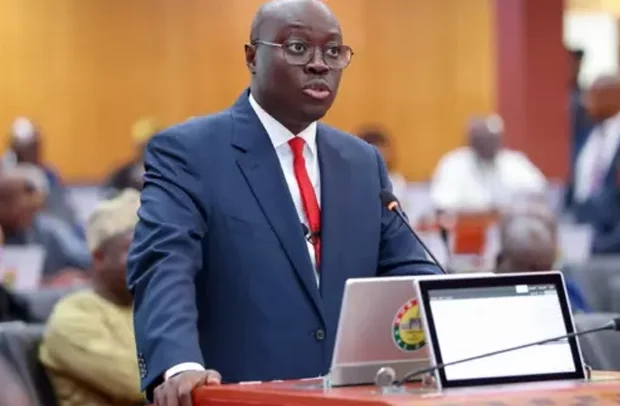
Dr. Cassiel Ato Baah Forson
Parliament has passed the Value for Money Office Bill, 2026, marking a significant step toward strengthening transparency, efficiency and accountability in the country’s public financial management system.
The bill, which has now been read for the third time and duly approved, seeks to establish a specialised Value for Money Office to regulate, monitor, coordinate and conduct value-for-money assessments across government expenditure and procurement processes.
Presented to the House by the Minister for Finance, Dr. Cassiel Ato Baah Forson, the legislation is aimed at addressing longstanding concerns over inflated contracts, cost overruns, abandoned projects and weak accountability mechanisms within the public sector.
The memorandum accompanying the bill highlighted deep-rooted inefficiencies in the nation’s expenditure management framework, noting that existing laws such as the Public Procurement Act and the Audit Service Act largely focus on procedural compliance rather than evaluating whether public spending delivers optimal value.
It further pointed to inconsistent pricing across Ministries, Departments and Agencies (MDAs) and Metropolitan, Municipal and District Assemblies (MMDAs), often driven by the absence of standardised cost benchmarks.
The situation has been compounded by the cessation of operations of Crown Agents, which previously conducted value-for-money assessments, leaving a significant institutional gap.
The Office, when established, is expected to fill this void by introducing a structured framework that ensures every cedi spent by the government yields maximum benefit in terms of efficiency, effectiveness, equity and sustainability.
It will also issue Value for Money Certificates before major contracts are awarded, monitor compliance and enforce sanctions where necessary.
The government said globally, similar frameworks exist in countries such as the United Kingdom, Canada and the United States, where institutions like the National Audit Office and Government Accountability Office ensure prudent use of public funds.
According to the Finance Minister, the adoption of this model is expected to align Ghana with international best practices and boost investor confidence.
During deliberations, the Finance Committee of Parliament underscored the importance of maintaining comprehensive records of value-for-money assessments.
Members noted that proper documentation would create a reliable database to guide future procurement decisions, policy formulation and parliamentary oversight, while preventing the loss of critical institutional knowledge.
The Committee also highlighted the need for the Office to play a strong preventive role through technical advisory services and capacity building.
It recommended the development of accredited training programmes and practical guidelines for public institutions to promote a uniform understanding of value-for-money principles.
On funding, the Committee stressed that the effectiveness and independence of the Office would depend on adequate and predictable financing.
It proposed that the Office be funded primarily through budgetary allocations and should not be allowed to contract loans, a recommendation that was rejected by Members of Parliament (MPs) during a consideration at the plenary session.
The Committee again proposed that the Office or its bearers should not receive gifts, a recommendation that was incorporated into the bill.
By Ernest Kofi Adu, Parliament House