
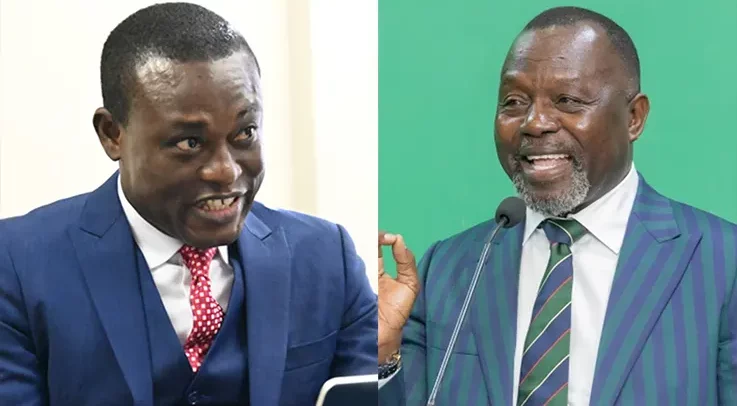
Kissi Agyebeng and Dr. Dominic Ayine
The public discourse surrounding the relevance and powers of the Office of the Special Prosecutor (OSP) has taken a different twist, with the Attorney General (AG) filing documents to challenge Parliament’s decision to delegate its prosecutorial powers to the OSP, arguing it is unconstitutional.
A proposed statement of the AG’s case to a writ pending before the Supreme Court is asking the apex court to declare section 4(2) of the Office of the Special Prosecutor Act, 2017 (Act 959) unconstitutional and consequently struck down.
Section 4(2) of the OSP Act mandates the Attorney General to authorise the OSP to initiate the prosecution of corruption and related offences.
But the proposed statement of case filed by Deputy Attorney General, Dr. Justice Srem-Sai, argues among others that Parliament cannot compel the Attorney General to mandate the OSP to initiate and prosecute corruption and related offences.
According to the proposed statement, the OSP has been investigating such allegations and suspicions, and prosecuting the offences that relate to them, “even without such requisite authorisation by the Attorney General.”
Originating Suit
A private citizen, Noah Ephraem Tetteh Adamptey, has filed a suit at the Supreme Court challenging the Act establishing the OSP.
He is seeking among others, a declaration that on a true and proper interpretation of the Articles 1(2), 88, 93(2), and 296 of the 1992 Constitution, prosecutorial authority in Ghana is vested exclusively in the Attorney General and cannot be exercised independently of, or in parallel with, the Attorney General.
He is also seeking declaration that the OSP Act, to the extent that it purports to confer original, autonomous, or insulated prosecutorial authority on the OSP is inconsistent with and in contravention of Articles 1(2), 88(3) – (4), 93(2), and 296 of the Constitution and is therefore null, void and of no effect.
Again, he wants a declaration that Parliament acted ultra vires its legislative authority under Article 93(2) in purporting, through Act 959, to compel a permanent delegation of the Attorney General’s prosecutorial powers to the Office of the Special Prosecutor.
The plaintiff is, therefore, asking the Supreme Court to strike down or server the provisions of Act 959 that “confer autonomous prosecutorial authority on the Office of the Special Prosecutor or insulate it from the Attorney General’s constitutional control.”
Proposed Statement of Defence
Deputy Attorney General, Dr. Justice Srem-Sai, in a proposed statement of case in defence attached to an application for extension of time, is asking the apex court to declare that Parliament has, by an ordinary legislation, varied the constitutional prosecutorial powers of the Attorney General, thereby acting in excess of its powers.
He further argues that the prosecutorial powers of the Republic vests in the Attorney General alone, in respect of all crimes.
He also argues that the OSP Act does compel the Attorney General to authorise the OSP to prosecute offences, emphasising that “Parliament may not compel the Attorney General to authorise a person to prosecute an offence.”
“By compelling the Attorney General to “authorise” the Office to initiate and conduct prosecutions, Parliament has, in effect, invariably taken over the discretionary of power of the Attorney General under Article 88(4) and has exercised the same. This compulsion is inconsistent with the discretion which the Constitution grants, exclusively, to the Attorney General.”
Again, the Deputy Attorney General argues that besides compelling the Attorney General to delegate his prosecutorial powers, the OSP Act varies the Attorney General’s prosecutorial power in many ways, including “the donation of the power to the Office also divests the Attorney General of his control over the Office’s use of the power.”
Another argument is that prosecutorial power may not be delegated to a juridical person but an actual human being.
The Deputy AG argues that the OSP Act did not make the Special Prosecutor (a human being) the recipient of the prosecutorial power but rather “it purports to make the “Office” – an artificial person – the recipient of the purportedly delegated prosecutorial power.”
“Accordingly, we pray your Lordships to adjudge and declare that Parliament has, to the extent of purporting to vary the prosecutorial power of the Attorney General, acted in excess of its powers,” Dr. Justice Srem-Sai adds.
BY Gibril Abdul Razak