
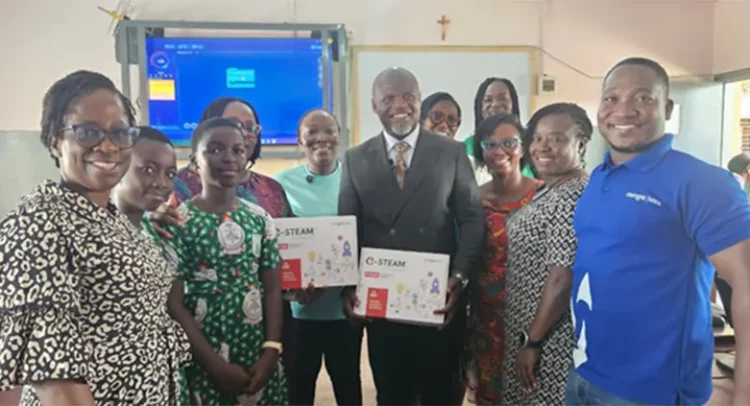
Kwesimintsim MP, Philip Buckman visits a Telecel Digitech Academy School in his constituency ahead of the cohort 4 commencement
Five underserved regions across the country are set to benefit from expanded digital skills training as the Telecel Ghana Foundation rolls out the fourth cohort of its DigiTech Academy, targeting 500 basic school students with hands-on technology education.
The initiative, which is being implemented in partnership with the Ghana Education Service, comes at a time when efforts to strengthen Science, Technology, Engineering and Mathematics (STEM) education are gaining national attention.
The DigiTech Academy, part of the Foundation’s Connected Learning programme, is a 12-week after-school intervention designed for upper primary and junior high school students.
It blends classroom learning with practical training, equipping participants with skills in robotics, coding and web application development.
Through weekly in-person sessions, students gain hands-on experience and are guided to develop functional digital solutions aimed at addressing real challenges within their communities by the end of the three-month programme.
The latest cohort, which commenced in early May, is being implemented in Yendi in the Northern Region, Sawla in the Savannah Region, Nalerigu in the North East Region, Effiakuma in the Western Region, and Enchi in the Western North Region, marking a significant expansion of the programme’s reach.
To ensure sustainability, teachers from participating schools received prior training from implementing partners, Mingo Foundation and Asustem Robotics, which enabled them to continue mentoring students beyond the programme period.
Rita Agyeiwaa Rockson, Head of Foundation, Sustainability and External Communications at Telecel Ghana, said the initiative is driven by a commitment to bridge the digital divide and empower young learners with relevant skills.
“We believe every child, regardless of where they live, deserves the opportunity to understand the digital world and the skills needed to build innovative tech-driven solutions,” she said, adding that each cohort contributes to building a pipeline of digital talent.
In the Effia-Kwesimintsim Municipality, the programme has already received strong backing from local authorities. During a courtesy visit to St. Anthony of Padua Primary and JHS, Member of Parliament for Kwesimintsim Constituency, Philip Fiifi Buckman, urged participating students to take full advantage of the opportunity.
“It will help you solve problems and understand digital skills beyond social media, to build solutions for our community and nation,” he said.
Delivered in collaboration with the Ghana STEM Centre, the DigiTech Academy aligns with the national curriculum and complements ongoing efforts to improve digital literacy in schools.
Since its pilot phase in Ho Dome in the Volta Region with just 50 students, the programme has expanded significantly, impacting more than 2,000 learners nationwide.
With girls comprising nearly 70 per cent of beneficiaries, the initiative also aims to address gender disparities in STEM fields.
Participants in previous cohorts have developed a range of practical innovations, including smart irrigation systems, firefighting robots, assistive devices for the visually impaired, e-commerce platforms, flood detection systems and automated security alarms.