
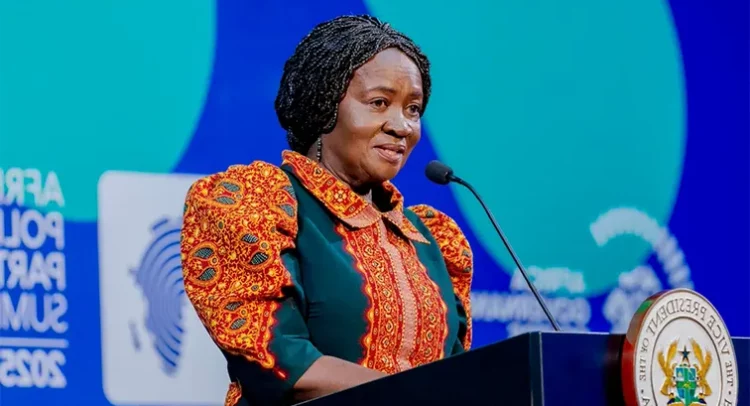
Prof. Naana Jane Opoku-Agyemang
Government has announced plans to collaborate with Rwanda, Zambia and other African countries to pilot a continental digital trade corridor aimed at strengthening cross-border commerce.
Vice-President Naana Jane Opoku-Agyemang, who disclosed this at the 3i Africa Summit 2026 in Accra, said the initiative would enhance cross-border transactions, digital identity systems and economic integration across the continent.
According to the Vice-President, the pilot, which is designed to test and measure the effectiveness of the digital trade corridor, will accelerate Africa’s participation in the global digital economy.
She explained that the initiative would focus on mobile money interoperability, mutual recognition of digital identities for cross-border Know-Your-Customer (KYC) processes, and harmonised electronic pre-invoicing systems.
“For decades, Africa has often been described as a ‘frontier,’ a characterisation frequently used by external observers. However, policymakers now emphasise that the priority lies not in labels but in how African nations organise themselves to compete, integrate and scale their economies,” she said.
The Vice-President added that Ghana’s positioning as a gateway to Africa is being redefined, stressing that such a role must go beyond symbolism and be measured by efficiency in transactions, speed of business connectivity and certainty in market operations.
She noted that Ghana’s role is supported by its long-standing political stability, commitment to openness and its hosting of the secretariat of the African Continental Free Trade Area (AfCFTA).
Touching on evolving global dynamics, she stated that economic influence is no longer determined solely by proximity to ports or trade volumes, but increasingly by who builds infrastructure, sets regulatory standards and sustains confidence in emerging markets.
“Economic sovereignty is now closely tied to digital integration, where value is created, exchanged and controlled. From smallholder farmers and traders to software engineers, participation in the modern economy depends on the ability to transact securely, establish identity and operate seamlessly across borders,” she added.
She further observed that while Africa has demonstrated its capacity to leapfrog legacy systems through innovations such as mobile money and financial technology, the challenge remains scaling these successes across the continent.
Vice-President Opoku Agyeman acknowledged that regulatory alignment remains a hurdle, noting that although full uniformity is not required, fragmented legal frameworks increase the cost of doing business and hinder innovation.
“Policymakers emphasise the need for coordinated regulations, shared standards and regulatory sandboxes to facilitate practical collaboration across jurisdictions,” she said.
She also pointed out that Africa accounts for a relatively small share of global data centre capacity, raising concerns about performance and data sovereignty. Investments in broadband, cloud infrastructure and digital systems are therefore critical to supporting integration.
Despite these challenges, she expressed optimism about Africa’s prospects, describing the continent as the world’s youngest with rapidly growing technology adoption and strong potential to shape the next phase of global digital growth.
“Governments are being urged to move beyond dialogue and demonstrate tangible progress, ensuring that digital integration is not only discussed but actively implemented across the continent,” she added.
The summit, which runs from May 6 to 8, 2026, is being held under the theme: “The Next Frontier: Shaping Africa’s FinTech Future.”
By Ebenezer K. Amponsah