
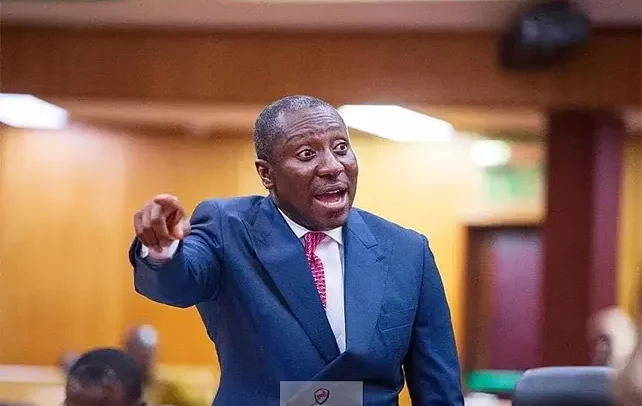
Alexander Afenyo Markin
The Minority in Parliament has condemned the arrest of some members of the opposition New Patriotic Party (NPP), warning that the development poses a threat to free speech and democratic governance in the country.
Delivering a statement on the floor of Parliament yesterday, the Minority Leader, Alexander Afenyo-Markin, described the arrests as deeply troubling and urged the House to defend the constitutional rights and liberties of all citizens regardless of political affiliation.
According to him, the issue transcends partisan politics and strikes at the heart of the nation’s democratic values and commitment to constitutional rule.
“What is happening in this country today goes beyond partisan politics. It is a question edged into the conscience of the nation itself about the kind of Ghana we are, and whether we still have the courage to remain the Ghana we promised the world would be,” he said.
The Minority Leader said the country’s democratic credentials had been earned through decades of sacrifice, civic vigilance and adherence to constitutional principles, stressing that any attempt to restrict free expression could undermine those gains.
He noted that freedom of expression, guaranteed under Article 21(1)(a) of the Constitution, remained a fundamental right and a cornerstone of democratic governance.
“The right to free expression is a birthright. It is the oxygen of democracy, and when that oxygen is restricted, the body politic begins quietly and dangerously to suffocate,” he stated.
Mr. Afenyo-Markin argued that the arrests of opposition members had unsettled civil society, alarmed legal practitioners and created anxiety among sections of the public.
He said citizens become fearful when they begin to question whether the laws and institutions meant to protect them still apply equally to all, warning that such fears could damage public confidence in democratic institutions.
While acknowledging the authority of the courts and the need for the law to apply equally to all citizens, the Minority Leader cautioned against the potential misuse of legal processes.
“We do not dispute the authority of the courts. We do not question that the law must apply equally to all, but we also know that the law can be technically applied and fundamentally abused at the same time,” he said.
The Minority Leader further cautioned that Ghana risked damaging its reputation as one of Africa’s leading democracies if citizens perceived that political dissent was being suppressed.
Mr. Afenyo-Markin appealed to members on both sides of the House to uphold democratic principles and ensure equal treatment for all political actors.
Responding to the statement, the Minister for Communication, Digital Technology and Innovations and Member of Parliament for Ningo-Prampram, Samuel Nartey George, rejected suggestions that free speech was under threat in the country.
He pointed to improvements in Ghana’s international press freedom rankings, arguing that the country had made significant progress under the administration of President John Dramani Mahama.
Mr. George stated that Ghana currently ranks 39th out of 180 countries in the World Press Freedom Index and fourth in Africa, compared to 62nd position in 2023.
He also argued that freedom of expression carries responsibilities and cannot be used to justify calls for violence.
“There can be no explanation of saying that you wish to see the President of the land and his wife killed and tell me that that is freedom of speech. That cannot be freedom of speech,” he said.
The Damongo MP, Samuel Abu Jinapor, who also contributed to the debate, backed the Minority Leader’s concerns and urged Parliament to approach the issue from a non-partisan perspective.
He argued that there was a clear distinction between press freedom and freedom of speech, insisting that the Minority’s concerns centred on the protection of free speech.
Mr. Jinapor maintained that in many cases where speech is considered offensive or defamatory, civil remedies rather than criminal sanctions should be pursued.
By Ernest Kofi Adu, Parliament House