

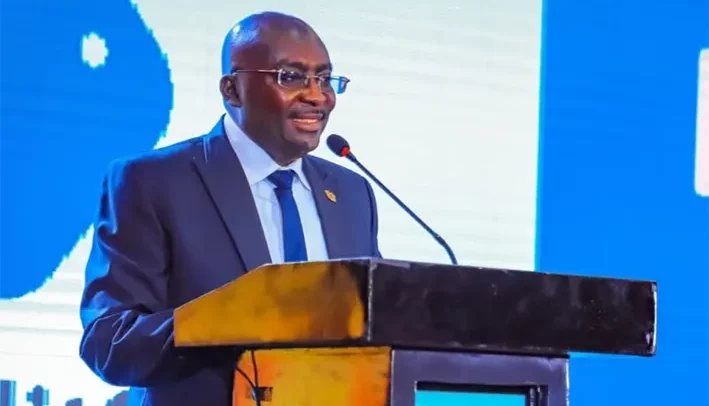
Dr. Mahamudu Bawumia
Former Vice President, Dr. Mahamudu Bawumia, has called for a unified, borderless policy approach to artificial intelligence (AI) across Africa, warning that fragmented national strategies could leave the continent trailing in the rapidly evolving global digital economy.
Delivering a keynote address at the London School of Economics (LSE) Africa Summit 2026 in the United Kingdom, Dr. Bawumia stressed that Africa must treat artificial intelligence not merely as imported technology but as a strategic continental capability that requires coordination, investment, and shared governance frameworks.
He argued that AI has become central to global competition, shaping productivity, security, and economic opportunity, and therefore demands a collective African response that transcends national borders.
According to him, a fragmented approach risks weakening Africa’s influence, while a coordinated strategy could position the continent as a co-creator of global technological rules and markets.
“Africa cannot afford to be a passive consumer in the knowledge economy,” he said, noting that the continent must build its own technological capacity and link it across countries to unlock shared benefits.
Dr. Bawumia placed the AI debate within the broader context of historical technological shifts, observing that Africa missed out on previous industrial revolutions due to limited investment in research, infrastructure, and innovation ecosystems.
He warned that failure to act decisively in the fourth industrial revolution, driven by artificial intelligence, big data, and the Internet of Things, would deepen existing inequalities.
He identified inadequate investment in technology and weak enabling environments as key factors behind Africa’s past setbacks, stressing that the continent does not lack talent but rather the leadership and deliberate policies needed to support innovation.
The former Vice President emphasised that Africa’s policy response must focus on building foundational systems before pursuing advanced applications.
These include reliable electricity, widespread internet connectivity, robust digital infrastructure, and strong institutions capable of regulating and supporting AI development.
He further highlighted the importance of skills development, urging governments to prioritise education and training in Science, Technology, Engineering, and Mathematics (STEM) to prepare the continent’s youthful population for the demands of the digital age.
On governance, Dr. Bawumia called for harmonised regulatory frameworks that promote innovation while safeguarding data privacy, security, and ethical standards.
He noted that inconsistent regulations across countries could hinder cross-border collaboration and limit the scalability of African tech solutions.
He also underscored the economic implications of AI, describing it as a tool for enhancing productivity across sectors such as agriculture, healthcare, finance, and public administration.
However, he cautioned that without deliberate policies, the benefits of AI could remain concentrated in a few regions, exacerbating inequality within and between countries.
Dr. Bawumia urged African leaders to adopt a mindset that embraces technological change rather than fears it, advocating bold but coordinated action to ensure the continent remains competitive.
“Africa must act decisively, but also cooperatively,” he said, adding that unity in policy design and implementation would be critical in leveraging AI for inclusive growth.
Beyond national considerations, he framed AI as a matter of sovereignty and strategic autonomy, arguing that control over data and digital infrastructure will define economic power in the 21st Century.
He, therefore, encouraged African countries to collaborate in building shared digital assets and innovation ecosystems.
The address also carried broader implications for investment and global partnerships, with Dr. Bawumia signalling that a coordinated African AI strategy could attract international investors seeking scalable and integrated markets.
The summit, attended by policymakers, academics, and industry leaders, focused on Africa’s future in a rapidly changing global landscape.
By Ernest Kofi Adu