
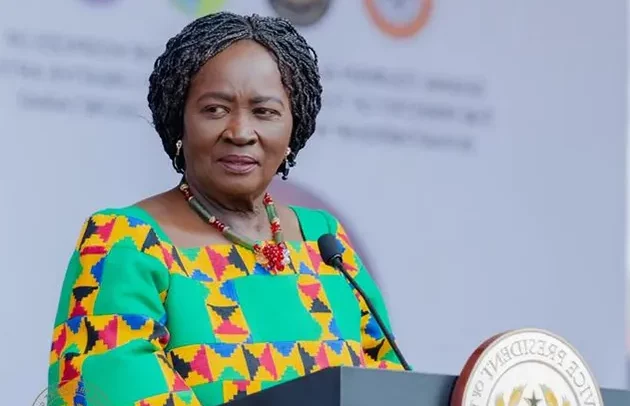
Vice President Prof. Naana Jane Opoku-Agyemang
The government has officially declared the Greater Cape Three Points area in the Western Region as Ghana’s first Marine Protected Area (MPA), marking a major step in the country’s efforts to safeguard its marine resources.
The declaration was made by Vice President Prof. Naana Jane Opoku-Agyemang, at a ceremony held at Busua in the Ahanta West Municipality yesterday.
“I hereby formally declare Greater Cape Three Points Marine Protected Area,” she announced.
The designation forms part of Ghana’s commitment to ocean conservation and aligns with the global “30×30” biodiversity target, which seeks to protect 30 percent of the world’s oceans by 2030.
Addressing stakeholders, Prof. Opoku-Agyemang described the move as a bold, science-driven intervention to reverse declining fish stocks and protect marine ecosystems.
“Government has therefore chosen to act boldly, and the Marine Protected Area that we declare today is a critical measure in our national strategy,” she said.
“The protection of this area goes far beyond conserving fish; it secures the ecological foundation of sustainable fisheries and the communities that depend on them,” she added.
The protected zone, located at Greater Cape Three Points, spans over 703 square kilometres along the coastline between Ampatano and Domunli.
It serves as a breeding and nursery ground for key fish species such as sardinella, anchovies and mackerel, while also providing migratory routes for whales and dolphins as well as nesting habitats for endangered sea turtles.
The initiative follows years of advocacy and technical work, with early efforts dating back to 1999 and renewed momentum in 2010 through the work of conservation groups, including Hen Mpoano.
The organisation’s director, Kofi Agbogah, called on coastal communities to support the initiative to ensure its success.
According to him, the initiative requires partnership for long term success, including support for ecological monitoring and data collection
“Ghana is ready to lead, and the real work begins now. We must continue to strengthen governance and learn from global best practices,” he said, referencing experiences from countries such as Kenya, Tanzania and Senegal.
The Minister for Fisheries and Aquaculture, Emelia Arthur, disclosed that the impact of the MPA would be far-reaching.
“This moment will be remembered as the day Ghana took a bold and irreversible step to protect her oceans, restore her fisheries and secure the future of her coastal communities,” she stated.
She noted that the initiative is central to Ghana’s blue economy agenda, which integrates sectors such as fisheries, tourism, energy, environment and natural resources.
“This marine protected area is a cornerstone of Ghana’s blue economy vision, and Ghana’s blue economy comprises the tourism, environment, lands and natural resources, energy, and fisheries sectors, and we are working together to ensure that we sustainably harness our ocean resources for economic growth, job creation and environmental resilience,” she added.
By Vera Owusu Sarpong & Emmanuel Opoku