

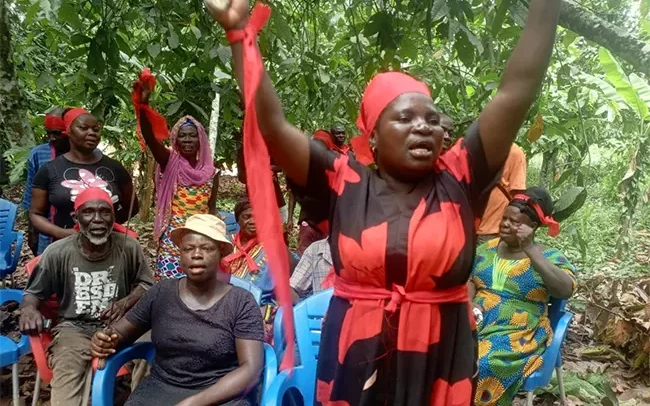
Angry cocoa farmers in parts of the Eastern Region have intensified their protest against the recent producer price cut, warning that the decision is crippling their livelihoods and pushing some to the brink of abandoning cocoa farming altogether.
The farmers, drawn from Kade, Ofoase and surrounding communities, voiced their frustrations during a visit by members of the Minority in Parliament led by the Chief Whip, Frank Annoh-Dompreh, on Tuesday.
Some of the farmers carried placards with inscriptions critical of the government, denouncing the price reduction and delays in payment for cocoa beans already supplied.
One farmer lamented that the situation had made it impossible to meet basic family obligations. “Today, we can’t buy books for our children at the university. How do I buy these books when the government has not paid for the cocoa beans it bought?” he questioned.
He further argued that cocoa remains the backbone of the Ghanaian economy and should be treated as such. According to him, if the government attributes the price cut to falling global market prices, then cocoa-growing communities should be cushioned just as citizens were during the COVID-19 pandemic.
“As COVID-19 came in former President Nana Akufo-Addo’s time and we were relieved of electricity and water bills, this is COVID number two for us. Government should ensure cocoa-growing communities do not pay electricity and water bills because of the price cut,” he said.
Cocoa farmer Grace Amponsah from Akyem-Techiman described the development as devastating, particularly for women who depend heavily on cocoa income to care for their families.
“Two-thirds of the nation’s population are women and we use cocoa to take care of our children. How do we make up for the shortfall due to the price cut?” she asked.
She appealed to the government, through the area’s Member of Parliament, to consider cutting public sector salaries and reducing fees at nursing and teachers’ training colleges to ease the burden on struggling farmers.
She also revealed that she was contemplating selling her cocoa farm to illegal miners, popularly known as galamsey operators, due to mounting financial pressure.
“If you hire a labourer, you have to pay GH¢120. With this price cut, how do we contract these labourers? We can’t even afford common rice,” she lamented.
Another farmer, Dennis Amoako, dismissed claims that some farmers had welcomed the decision. “If it is not for politics, no cocoa farmer will appreciate this price cut. It has disorganised household budgets. We reject it,” he stated.
He questioned why the burden of international price fluctuations should be borne solely by farmers. “Government does not want to absorb the loss. Why should we bear the brunt?” he asked rhetorically.
The Krontihene of Akyem-Techiman, Baffour Kyei Danso, also criticised the approach, insisting that the government should not take such decisions without consulting cocoa farmers and traditional authorities.
The farmers are demanding immediate payment for cocoa beans already supplied and a review of the price cut to prevent what they describe as the gradual collapse of cocoa farming in their communities.
By Ernest Kofi Adu