
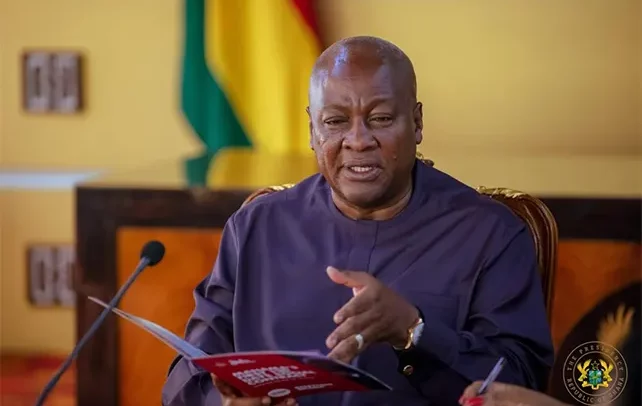
President John Mahama
The tendency of NDC governments to abandon projects initiated by their predecessors whenever they assume power has become a defining feature of the political tradition, and it is regrettable.
The cost of this anomaly is enormous, and the ultimate losers are Ghanaian taxpayers who continue to be burdened with an assortment of taxes. Indeed, even the proceeds from the dumsor levy remain unaccounted for.
From the affordable housing projects initiated by former President John Agyekum Kufuor to the Agenda III health facilities spread across the country, the evidence supporting this assertion is overwhelming.
The claim by observers that there are financial advantages to be gained when ongoing projects are abandoned for new ones may appear convincing.
Another reason often attributed to this practice is the desire to deny predecessors the public relations credit that would accrue to them when such projects are eventually commissioned. Leaving projects to deteriorate, even when they are at advanced stages of completion, appears not to matter to the government.
The financial benefits that may arise from procurement breaches are arguably behind decisions such as abandoning bypass projects on the Accra-Kumasi highway, many of which were over 70 percent complete, in favour of a new expressway project.
The proposed expressway between the two major cities is unlikely to be completed before the tenure of President John Dramani Mahama ends, yet his administration has chosen to abandon projects initiated by its predecessors in favour of starting new ones that may equally remain incomplete. By the time he exits the corridors of Jubilee House, his own project could join the long list of abandoned works.
This does not demonstrate prudent management of national resources. Ironically, despite this recurring anomaly, an office of state has been established specifically to ensure prudent resource management. What an irony.
The Agenda III health facilities in several parts of the country are at advanced stages of completion, yet many have become havens for reptiles, while exposure to harsh weather conditions continues to affect their quality.
During his campaign, the President promised that these projects would be completed. So far, he has failed to fulfil that promise, and there appears to be little urgency in doing so.
The previous government initiated and completed the Weija Paediatric Hospital, yet the facility continues to deteriorate because the current administration has failed to commission it.
The reasons advanced by the government for the delay have attracted legal threats from the contractors, who dispute what they describe as propaganda-driven explanations for the refusal to operationalise the facility.
The contractors have raised a serious concern: the sophisticated and sensitive equipment installed at the hospital requires constant and efficient air-conditioning to remain functional. Without this, the integrity and quality of the equipment cannot be guaranteed.
It is shameful how the Health Ministry would put forth mendacious claims about why it is unable to have the facility commissioned.
Government’s claim that procurement shortcomings are among the reasons for the delay only adds to the growing concerns about transparency and accountability among those at the helm of governance in the country.