

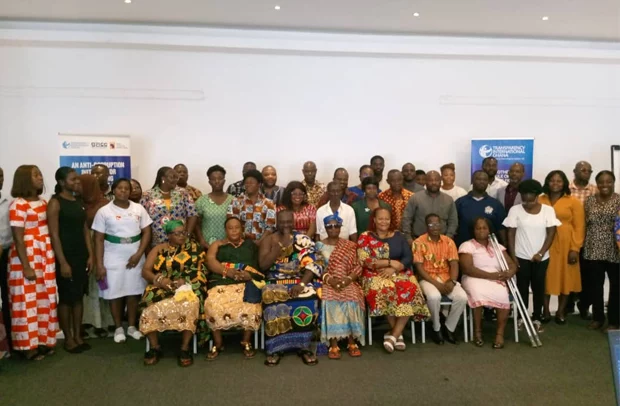
Some of the participants
Transparency International Ghana has bemoaned the fact that corruption remains a persistent governance challenge which demands urgent and decisive action.
It has therefore called on government to advance bold and credible policies to help root out corruption.
“This is no longer about addressing emerging risks, it is about confronting a challenge that has matured and requires firm, sustained institutional response,” it added.
The Executive Director of Transparency International Ghana, Mrs. Mary Awelana Addah, disclosed this at a workshop organised in Takoradi on the collaborative roles that civil society organisations, trade unions, and the media can play in the fight against corruption.
It was organised in collaboration with the Ghana Anti-Corruption Coalition and the Africa Centre for Energy Policy (ACEP), with support from the Foreign, Commonwealth and Development Office Governance Programme.
The event was attended by traditional leaders, representatives from the Commission for Human Rights and Administrative Justice (CHRAJ), National Commission for Civic Education (NCCE), trade unions, academia, business associations, heads of civil society organisations (CSOs) and the media.
Madam Addah lamented that corruption continues to erode public trust, weaken institutions, and distort development outcomes.
She noted that the menace transcends political cycles, and it is fundamentally a systemic governance issue whose consequences extend across institutions and generations.
“It is within this framework that Transparency International Ghana, formerly Ghana Integrity Initiative, in partnership with ACEP and the Ghana Anti-Corruption Coalition, is advancing this multistakeholder platform,” she noted.
She said, “The project places particular emphasis on mobilising key stakeholders to support anti-corruption initiatives, particularly, within the context of Ghana’s recent electoral cycle and governance transition.”
Madam Addah pointed out that anti-corruption discourse has historically been framed largely around the actions of sitting governments.
“While such an approach may appear administratively straightforward, it often narrows a complex governance challenge into a simplified political narrative,” she added.
She asserted that when accountability conversations are viewed solely through the lens of government interventions, they risk reinforcing familiar partisan divisions rather than illuminating deeper structural, institutional, and societal drivers of corruption.
She was hopeful that such engagements would help deepen understanding and strengthen the collective resolve for accountability.
From Emmanuel Opoku, Takoradi