
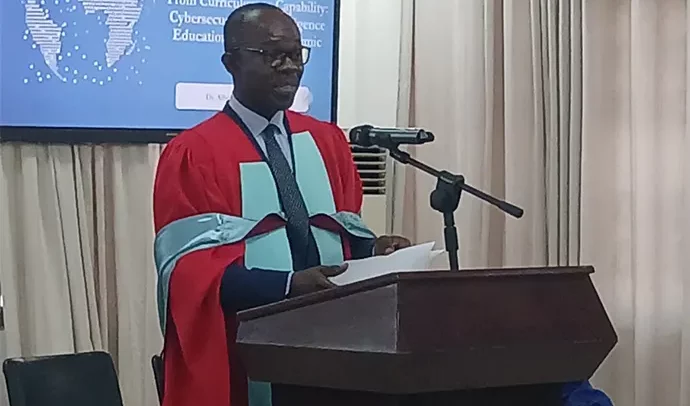
Dr. Albert Antwi-Boasiako
Founder & Executive Chair, e-Crime Bureau, Dr. Albert Antwi-Boasiako, has issued a stirring call to action for the global education system, warning that the rise of the “Algorithmic Era” necessitates a radical shift from traditional academic curricula to a model based on “disciplined judgement” and “real-world capability.”
Speaking at the official launch of MSc programmes in Cyber Security and Digital Forensics, and Security & Intelligence hosted by the Accra Metropolitan University in partnership with e-Crime Bureau, Dr. Antwi-Boasiako described a civilisation-altering shift where computational logic increasingly dictates human thought, knowledge distribution, and social organisation.
He explained that the Algorithmic Era refers to the current and emerging period in human history in which algorithms, basically set of rules, instructions and mathematical models executed by computers have become the primary drivers of decision making.
”The Algorithmic Era is also defined by the ascendancy of computational logic over human judgement. A civilisation altering shift in which algorithms increasingly determine what we see, what we know, what we are offered, and ultimately, how we think,” he added.
He stated that, it is an age where human experience is continuously harvested and transcribed into data, fed into systems of automated decision making that operate at a scale and speed no human mind can match, and where the creation of even reality itself has been quietly delegated to mathematical representations.
According to him, algorithms are trained on biased data, and they are mostly shaped by invisible assumptions. Thus, every algorithm carries a philosophy, whether acknowledged or not.
”Cyber security and intelligence professionals must therefore become not only technically competent, but also philosophically aware,” he urged.
He argued that traditional modules are failing because they are designed for a world of “certainty,” while the modern cyber landscape is defined by “complex ambiguity.”
He cited alarming data from Checkpoint Research, noting that organisations now face nearly 2,000 cyber attacks per week, with many executed in seconds.
He urged universities to adopt a “future-ready” curriculum that prioritises philosophical training: educating students to interrogate the biases and assumptions embedded in mathematical models; and interdisciplinary integration: merging technology with law, ethics, and psychology.
A Call for National Strategy
Addressing the global shortage of 4 million cybersecurity professionals, Dr. Antwi-Boasiako emphasised that cybersecurity is a national asset. He, therefore, called on the government to develop intentional “capability pipelines”, and urged the industry to stop being passive consumers of talent and start being “active co-creators”.
Mr. Antwi-Boasiako offered a sobering warning. He argued that the greatest threat to humanity is not that machines will become too intelligent, but that humans will become passive, uncritical, and heavily dependent on algorithms.
For her part, the Acting Vice Chancellor of Accra Metropolitan University (Accra Met), Prof. Goski Alabi, said programmes in Cybersecurity, Digital Forensics, and Security and Intelligence are deliberately designed to respond to the evolving demands of the digital and security landscape, not only in Ghana but across Africa.
She noted that, through collaboration with e-Crime Bureau, the university is bridging the gap between curriculum and capability, ensuring that students gain not only knowledge but also hands-on experience, industry exposure, and professionally relevant skills.
”The partnership embeds practical learning and provides intelligence-driven insights and real-case exposure into academic delivery,” she said.
Prof. Alabi, who doubles as the Professor of Quality Management, Strategic Leadership and Corporate Governance, added that students enrolled in these programmes will emerge as graduates who are not just qualified but industry-ready, particularly those pursuing MSc Security and Intelligence and MSc Cyber Security and Digital Forensics.
Speaking on the theme of the event, “From Curriculum to Capability: Cyber Security and Intelligence Education in the Algorithmic Era,” she described it as a testament to the industry-integrated approach championed by e-Crime Bureau.
She further revealed that the university has a similar collaboration with the Electricity Company of Ghana (ECG) for its MSc Energy Management and Policy programme, as well as an upcoming diploma in Electrician Training.
Director-General, National Patrol Department (NPD), Ghana Police Service, COP/Alhaji Mohammed Fuseini Suraji, speaking on behalf of the Ghana Police Service, commended Accra Metropolitan University and e-Crime Bureau for organising the programme.
According to him, the introduction of postgraduate programmes in Cyber Security, Digital Forensics, Security and Intelligence is timely and strategic, as threats increasingly manifest in digital spaces.
”The partnership between academia and security institutions is essential to strengthen national capacity to prevent, detect and respond to cyber-related crimes,” he stated.
By Janet Odei Amponsah