

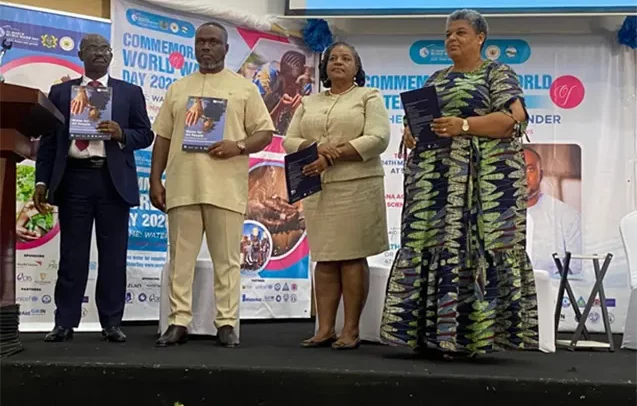
The minister and other dignitaries with the World Water Day report
The Minister for Gender, Children and Social Protection, Agnes Naa Momo Lartey, has called for greater inclusion of women in water governance, stressing that access to water is closely linked to gender equality, social protection and national development.
In a speech read on her behalf at the commemoration of the World Water Day in Accra, she said although women are at the center of water management at the household and community levels, they remain largely underrepresented in leadership and decision-making structures.
“Women must not only be beneficiaries of water services; they must be decision-makers, innovators and leaders,” the statement said.
She emphasised that water access has broader social implications beyond basic supply.
“When you talk about water access, you are also talking about women’s empowerment, girls’ education, health, dignity and safety,” she noted.
The Minister added that empowering women in water governance would improve outcomes for vulnerable populations.
“When women participate in and influence water systems, those who are most vulnerable, including children and persons with disabilities, benefit the most,” she said.
She further highlighted the need for deliberate policy action, stressing that, “the imbalance must change,” and called for structured efforts to ensure women are actively involved in decision-making processes.
She noted that equitable access to water is critical for poverty reduction and inclusive development, adding that improving water and sanitation services would strengthen social protection systems and support education and public health outcomes.
Meanwhile, the Minister for Works, Housing and Water Resources, Kenneth Gilbert Adjei, underscored the importance of sustainable and inclusive water management, while outlining progress made in the sector.
“Water is essential for health, food security, economic productivity, environmental sustainability and human dignity,” he stated.
He acknowledged that access to safe and reliable water remains a major challenge for many communities, particularly in developing regions.
“For millions of people, access to safe and reliable water remains a daily challenge,” he said.
He pointed out that the burden of water collection continues to fall disproportionately on women and girls.
“Countless women and young girls walk long distances in search of water for their households. The burden is not just physical; it also limits opportunities for education, economic empowerment and social participation,” he explained.
The Minister stressed that addressing water challenges requires inclusive policies.
“Improving water services is not only a development issue, but also a gender equality issue. Sustainable water management must be inclusive and equitable,” he added.
He outlined the government’s interventions aimed at expanding access to potable water and improving sanitation through key institutions such as the Ghana Water Company Limited, the Community Water and Sanitation Agency, and the Water Resources Commission.
“We have made significant progress in expanding access to potable water and improving sanitation services across the country,” he said.
He added that, “we have prioritised investments in water supply systems, including small-town water systems and the rehabilitation of urban infrastructure, to ensure that no community is left behind.”
He acknowledged that much remains to be done despite the great strides they have made.
“As we commemorate World Water Day, we recognise that much remains to be done,” he said.
He cited population growth, urbanisation and environmental pressures as key threats to water resources, stressing that addressing them would require collective action.
“These challenges require not only government action, but a collective responsibility involving civil society, the private sector, traditional authorities and communities,” he stated.
By Vera Sarpong