
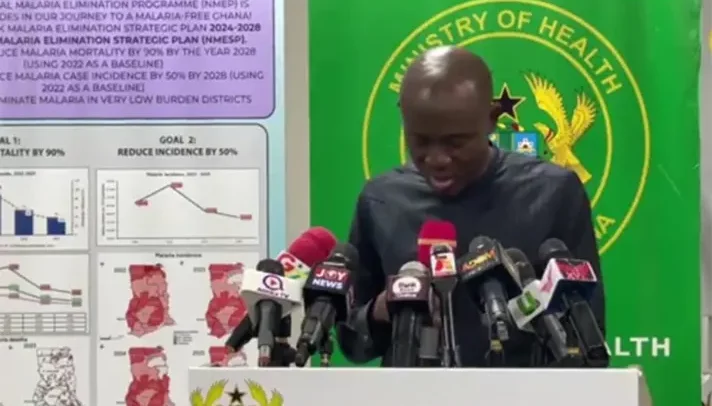
Dr. Franklin Asiedu-Bekoe speaking at the event
The Ministry of Health (MOH) has commemorated World Malaria Day in Accra under the theme “Driven to End Malaria: Now We Can. Now We Must”.
Speaking at the event, the Director of Public Health at Ghana Health Service (GHS), Dr. Franklin Asiedu-Bekoe, stated that malaria is a major public health concern in the country which affects thousands of individuals, particularly children under five years and pregnant women.
He stressed that despite the measures put in place by the GHS to reduce malaria in the country, challenges in the fight against the disease continues to affect its efforts, adding that malaria elimination requires investment from all sectors of the economy and society.
He mentioned that the domestic mobilisation of resources and the engagement of private sector is important in the malaria control efforts.
“We must increasingly mobilise domestic resources and engage the private sector, private sector investment is critical not only for bridging funding gaps but also for bringing innovation, efficiency and sustainability to our malaria control efforts,” he said.
Dr. Asiedu-Bekoe further used the opportunity to call on businesses, corporations and entrepreneurs to join in the national fight against malaria, noting that a malaria-free workforce is a productive workforce, and a healthy Ghana is a prosperous Ghana.
Also, the Deputy Programme Manager, National Malaria Elimination Programme (NMEP), Dr. Nana Yaw Peprah, stated that the country has moved from controlling malaria to its elimination.
He highlighted that the main mode of transmission of malaria is from the bite of an infected female anopheles mosquito.
He added that in Ghana, the risk of malaria has reduced over the years despite everybody being at risk of having the disease, stressing that the risk of transmission has also reduced.
Dr. Peprah indicated that in 2011, the mortality rate recorded across the country was 3,300, noting that the rate reduced to 52 last year, highlighting that work must be done to eliminate mortality rate completely.
He mentioned that there will be malaria vaccinations in areas where malaria transmission are seasonal, especially the northern part of the country where anti-malarial will be given during the raining season to prevent the spread of the disease.
He stressed that by 2024-2028, Ghana will eliminate malaria in 21 districts, reduce malaria mortality by 90 percent and also reduce overall malaria incident by 50 percent.
He added that malaria can be eliminated when communities are involved in the elimination process to understand the elimination agenda, noting that insecticide treated mosquito nets, indoor residual spraying among other factors contributing to the zero malaria agenda will continue.
The Ministry of Health has urged the general public to sleep under insecticide treated nets every night, seek early testing and treatment for fever and also support environmental cleanliness to reduce mosquito breeding.
GHS will embark on a health walk on Saturday, April 25, 2026, from the University of Ghana Business School to raise awareness and stimulate action at all levels of society.
By Florence Asamoah Adom