
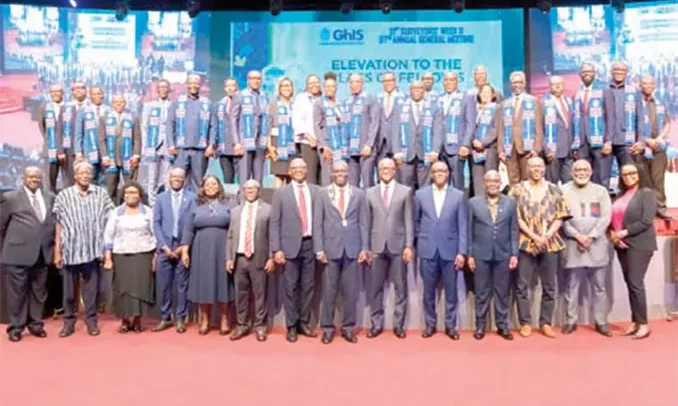
Participants at the Annual General Meeting
The Ghana Institution of Surveyors (GhIS) has renewed its call on Parliament to pass the long-delayed Surveying Council Bill, warning that continued delays are weakening efforts to regulate the profession and eliminate unqualified practitioners.
Speaking at the 21st Surveyors’ Week and 57th Annual General Meeting (AGM) held in Accra on February 23, 2026, President of the Institution, Surv. Kofi Obeng Ayirebi, described the proposed legislation as crucial to reforming the industry and strengthening public confidence.
“Securing surveying practice through an Act of Parliament is not merely a professional matter. It is a governance issue, an investment protection issue, and fundamentally a national security issue,” he said.
He stressed that land administration, valuation, infrastructure planning and spatial data management are central to national development and public accountability, and must be properly regulated.
Investment Capital Depends on Strong Land Systems
At the same event, the Managing Director of Petra Trust Company Ltd, Kofi Fynn, said billions of cedis in pension and insurance funds are available for long-term investment, but unlocking that capital will depend on credible land systems and high professional standards in the surveying sector.
Describing the conference as a pivotal moment for the profession, Mr. Fynn noted that about 275 new members were inducted into the Institution, while 28 members were elevated to fellowship.
He emphasised that surveyors are central to national development, pointing out that no road, building or major financial transaction can succeed without accurate surveys and reliable valuations.
With pension and insurance funds holding tens of billions of cedis in long-term capital, he said Ghana has a major opportunity to channel institutional investment into housing and infrastructure.
However, he cautioned that such capital requires secure land titles, precision, collaboration and strong ethical standards.
Land Bank, Digitalisation
Meanwhile, the Ministry of Lands and Natural Resources says it is taking concrete steps to address long-standing challenges in Ghana’s land administration system through the Land Bank and Digitalisation Project.
The initiative, being implemented with the Lands Commission, seeks to modernise land data management by establishing a centralised Land Bank and digitising land records and processes to improve transparency and efficiency.
Speaking at the Tema session of the event on February 26, the Minister for Lands and Natural Resources, Emmanuel Armah-Kofi Buah, acknowledged persistent setbacks in the land sector, including conflicting allodial boundaries, lack of transparency, low investor confidence and delays in title registration.
He said the Land Bank and Digitalisation Project is designed to address these bottlenecks, and disclosed that lands are already being secured to support large-scale commercial agriculture, particularly palm plantations.
To finance the initiative, government has approved 100 per cent retention of the Lands Commission’s internally generated funds, with 67 per cent allocated to the project.
On the Surveying Council Bill, the Minister said it is undergoing internal processes within the Ministry for onward submission to Cabinet, describing it as a personal priority.
Reiterating the profession’s relevance, Surv. Obeng Ayirebi said surveying underpins land administration, valuation, quantity surveying, mining, hydrographic services and geospatial intelligence — all critical to infrastructure, housing and urban development.
He maintained that accurate measurement, reliable valuation and effective cost management are indispensable to sustainable development, stressing that surveying does not merely support development but enables it.