

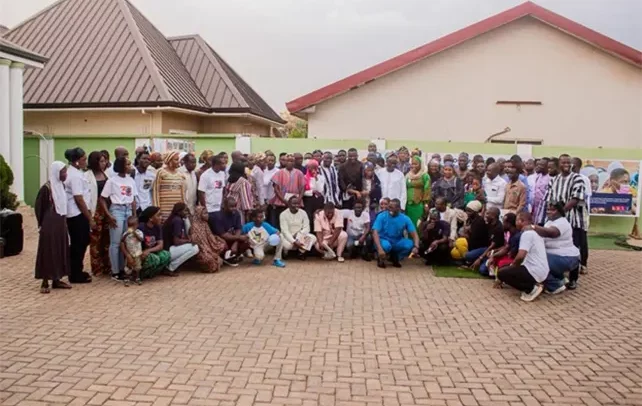
School for Life officials with participants at the event in Tamale
School for Life (SfL), as part of the Citizen-Led Actions for Educational Accountability and Responsiveness in Ghana (CLEAR) Project, has organised a national stakeholder’s convening on the state of public basic education and social inclusion in basic education in Tamale, the Northern region.
The CLEAR project is implemented by School for Life and its consortium partners and funded by the Global Partnership for Education.
The event, held under the themes; “Promoting Equitable Basic Education in Ghana’s Resetting Agenda” and “Building Inclusive Societies through Education; the role of national and sub-national actors” highlighted the progress made in Ghana’s basic education and social inclusion programming especially in Northern Ghana.
It also highlighted key gaps in government programmes and interventions to enhance quality learning outcomes and inclusive development processes.
The convening brought together practitioners from civil society, citizen groups, students, young people, government agencies, academia, donor agencies and other development partners, and the media to engender positive discourse and inspire critical reflections aimed at promoting equitable quality education delivery and enhancing the quality of wellbeing of marginalised people in the country.
Addressing participants, Director of School for Life, Wedad Sayibu, said education remains a cornerstone of Ghana’s social and economic transformation agenda and that foundational weaknesses threaten sustainable progress.
“Major studies, including the MoE’s Sector Performance Report (ESPR) of basic education financing, reveal chronic underinvestment in early childhood and primary education where learning deficits begin.
Thousands of KG and primary pupils still learn in dilapidated structures, and multi-grade teaching remains widespread due to teacher shortages, particularly in deprived districts. These constraints directly affect learning levels, contributing to Ghana’s high learning poverty indicators as noted in a recent World Bank finding,” she revealed
According to her, for the last thirty years, School for Life and partners have worked to expand access to quality basic education for children in underserved communities, particularly in Northern Ghana.
“From our early work in Complementary Basic Education (CBE) through which we have helped thousands of Out-of-School Children (OOSC) to become literate in their mother tongue, to our continuous advocacy for inclusive education systems, School for Life has remained a trusted and credible Civil Society Organisation championing the rights of children, communities, and schools. Our work has transformed lives, empowered families, and contributed to national policy reforms that are still shaping Ghana’s education landscape today,” she said
She disclosed than so far, over 456,500 children have passed through their CBE programme, some of whom have proceeded to the highest ladder in academia.
“Through the Citizen-led Educational Accountability & Responsiveness in Ghana (CLEAR) Project, citizens across several regions are teaming up to demand accountability in the education sector. We have constantly witnessed community members, parents, school management committees, youth groups, and local leaders take ownership of the education agenda, asking the right questions, and committing themselves to positive change. This is what the convening seeks to promote; active citizenship, informed advocacy, and a shared responsibility for improving learning outcomes,” she noted
The Director of School for Life, commended the government through the Ministry of Education led by Haruna Iddrisu for demonstrating commitment to ensuring that foundational and basic learning is given priority.
“Uncapping the Ghana Education Trust Fund (GETFund) means that more resources is freed to support education programmes. Through the 2026 budget, we have seen some funding allocation to areas such as desk production, accommodation for teachers in rural areas and classroom infrastructure. This will go a long way to mitigate the challenges faced by the basic education sub-sector. We would, however, like to entreat the Minister for Education to pay particular attention to the budgetary allocation to the complementary education programming and to humbly urge him to use his high office to ensure that the CBE programme is given some critical support,” she stated
School for Life (SfL) called for a national action to make GESI a School Governance priority, not an afterthought , invest in accessibility and dignity-enhancing school infrastructure, transform teaching workforce through sustained training in inclusive pedagogies, mobilize communities as co-guardians of children wellbeing and futures, and fix data and financing gaps.
The Minister of Education, Haruna Iddrisu, addressing participants indicated that his focus at the ministry of education is to strengthen foundational learning.
“My focus at the Ministry is to strengthen foundational learning which holds the key to the success of secondary education. We must increase investment and the support for basic education,” he said
He revealed that Ghana currently has about 5,000 schools under trees.
“Ghana still has about 5,000 schools under trees which is unacceptable and the disparity between the North and the South is widening as well as urban and rural areas which is troubling and so I am happy to work with School for Life and other CSOs,” the Minister noted
“We are reviewing the curriculum currently and I intend to introduce three significant things to foundational learning which are financial literacy skills, ethical integrity, electronics, artificial intelligence, coding, robotics,” he revealed.
“To promote inclusive quality education, we are increasing official Ghanaian languages taught in schools from 9 to 13 including sign language,” Mr. Iddrisu stated.
FROM Eric Kombat, Tamale