
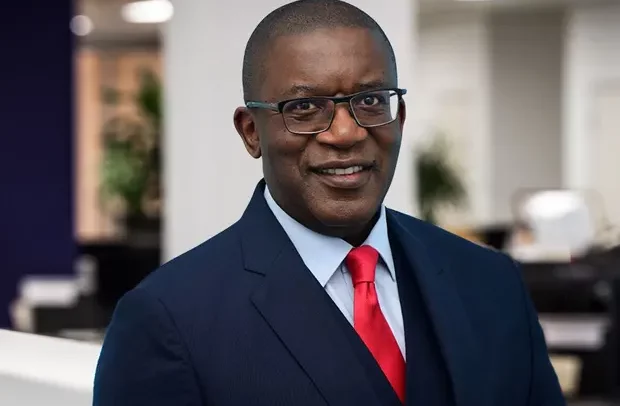
Solomon Asamoah
Counsel for former Chief Executive Officer of Ghana Infrastructure Investment Fund (GIIF) continued her cross-examination of the prosecution’s third witness, Francis Aboagye, a Staff Officer at the National Intelligence Bureau (NIB), with part of the questions focusing on the investigative cautioned statements and charge statements taken from the accused persons and some former board members of the GIIF.
Former Chief Executive Officer of GIIF, Solomon Asamoah and former Board Chairman of the Fund, Prof. Christopher Ameyaw-Akumfi are before the court for allegedly causing $2 million financial loss to the state by investing it in the Sky Train project.
Victoria Barth, counsel for Mr. Asamoah, primarily explored the propriety of the witness tendering the cautioned statements and charge statements rather than the police officer who recorded those statements.
It was her contention that in the absence of the police officer who took the statements, another police officer who was part of the investigation must tender them in evidence, and not the witness who is not a police officer.
The witness, however, disagreed with her, noting that the investigation was a team work and he as the leader of the team was the proper person to tender those statements.
He further indicated that he was not aware of any such specific requirement, but even if it is the case that a police officer must tender the statements in evidence, the Act that established the NIB gave him, an intelligence officer, the right, powers and duties of a police officer.
Mrs. Barth earlier explored the role of the witness in taking and recording of the cautioned and charge statements after noticing that all the statements were signed by a single police officer.
She suggested to the witness that he was not present when those statements were taken. The witness insisted that he was in the vicinity when the statements were recorded.
“So I would be correct to say that you were not in the room when the statements were recorded and signed by the various board members who gave cautioned and charge statements. Is that not so?” the lawyer asked.
“Yes, my Lady, if that is how you want to interpret it,” the witness answered. He later added that for many parts that those statements were taken, he “walked in intermittently to check if all was well.”
Evidence
Mr. Aboagye, in his witness statement before the court, basically testified to matters that have already been discussed by the prosecution’s first two witnesses, including the claim that the board of GIIF did not approve the Sky Train project.
He also testified that notwithstanding the substantial conditions of a Memorandum of Agreement involving the Ministry of Railway Development (MoRD), GIIF and Africa Investor Holdings (Proprietary) Limited, including the execution of a concession agreement and the conduct of bankable feasibility study by Africa Investor Holdings Limited prior to disbursement of fund, Mr. Asamoah went on and signed the shareholders’ agreement on behalf of GIIF with Africa Investor Holdings Limited.
“Our investigations, however, revealed that the GIIF board of directors did not authorise A1 (Mr. Asamoah) to purchase the shares. The board of directors was not also aware that A1 signed the shareholders’ agreement,” the witness added.
Further Cross-examination
Mrs. Barth, in her further cross-examination of the witness, shifted attention to the Memorandum of Agreement which, she said, is the “document that captures the genesis of the Accra Sky Train project.
The witness said he was not aware the MoU was the genesis of the project, adding that “what I’m aware of is that there were some deliberations before that MoU.”
“Do you agree that the MoRD according to exhibit 37 (MoU) selected Africa Investor to conduct a feasibility study in order to establish and or confirm the geotechnical feasibility among other due diligence for the project over an exclusive period without any mention of GIIF’s involvement?” the lawyer asked.
This question was objected to by Sefakor Batse, a Principal State Attorney, who argued that it was unfair and that the witness must be given an opportunity to read the document since it was only tendered yesterday.
She said the question must either be disallowed or the witness be given time to read the document.
Mrs. Barth disagreed, arguing that the fairness of the question is not in the ill-preparedness of the witness who is the lead investigator, “who at the minimum should have understood the genesis that led to the payment of the $2 million which his investigations claims to have found to be unlawful.”
Justice Audrey Kocuvie-Tay, in a ruling, held that it is only fair that the witness is given time to completely read the document and proceed to answer the question.
The case was adjourned to March 18 for continuation.
By Gibril Abdul Razak