
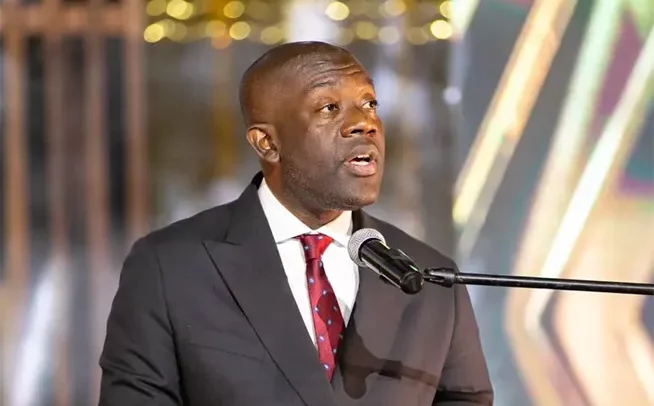
Kojo Oppong Nkrumah
A proposed amendment to the Public Financial Management Act 2016 (Act 921), popularly dubbed the “No Plan, No Cash Bill,” among Members of Parliament (MPs), has been laid before stakeholders with a strong call for tighter fiscal discipline and alignment between national planning and public expenditure.
The sponsor of the Private Member’s Bill, Kojo Oppong Nkrumah, said the Public Financial Management (Amendment) Bill, 2026, seeks to cure a long-standing gap that allows Ministries, Departments and Agencies (MDAs) and Metropolitan, Municipal and District Assemblies (MMDAs) to access government funds without securing prior approval of their development plans from the National Development Planning Commission.
Addressing participants at a stakeholder engagement in Accra yesterday, Mr. Oppong Nkrumah explained that while the Public Financial Management Act 2016 (Act 921) has served the country well, its implementation has exposed loopholes that undermine fiscal discipline.
“At our committee, we have nicknamed this the ‘No Plan, No Cash Bill’. If it’s not in the plan, you won’t get any cash,” he stated, stressing that the amendment seeks to deny the Ministry of Finance the authority to fund projects that are not captured and certified under approved development plans.
According to the memorandum accompanying the bill, the fundamental mischief it seeks to cure is the recurring practice of MDAs and MMDAs embarking on projects outside their approved plans, resulting in inefficient use of public resources, duplication of efforts and fragmentation of the national development process.
The amendment proposes that NDPC approval of development plans becomes a mandatory precondition for the preparation of annual budgets, issuance of expenditure warrants and disbursement of funds.
It also seeks to amend Section 21 of Act 921 to prohibit the Finance Minister from incorporating budget estimates of entities that are inconsistent with their approved development plans.
Mr. Oppong Nkrumah noted that although the NDPC is listed as a stakeholder in the budget preparation process under the existing law, the nature and binding force of its participation are not clearly defined.
This, he said, has weakened the Commission’s authority and created room for spending decisions driven more by institutional preference than national priorities.
Clerk to Parliament, Ebenezer Ahumah Djietror, described the engagement as a critical stage in the legislative process, emphasising that effective law-making must be grounded in broad consultation.
He said the bill aligns with Chapter Six of the Constitution on the Directive Principles of State Policy and aims to ensure that the national budget reflects the country’s long-term development vision.
“This bill consciously promotes efficient resource allocation and enhances accountability across all levels of government,” he noted, urging stakeholders to offer frank and constructive inputs.
The Deputy Clerk in charge of Legislation, Camilo Pwamang, commended the sponsor for investing time and resources into the legislative initiative.
He explained that under Parliament’s revised Standing Orders, Private Members’ Bills must undergo stakeholder consultations similar to public bills.
Mr. Pwamang added that the amendment would also empower the Finance Minister to withhold funding from non-compliant entities and tie releases from the District Assemblies Common Fund to NDPC-approved plans and progress reporting.
Stakeholders present included representatives from MDAs, MMDAs, civil society organisations, academia and development partners such as the World Bank and the Foreign, Commonwealth and Development Office.
The sponsor urged participants not only to contribute ideas at the consultative stage but also to follow the bill through Parliament’s formal processes.
After the legislative management services completes technical edits, the bill will be presented to the relevant committee before being formally laid and taken through the various readings and motions in the House.
“Our hope is that every cedi spent of our limited resources will be in pursuance of the National Development Plan,” Mr. Oppong Nkrumah said.
By Ernest Kofi Adu