
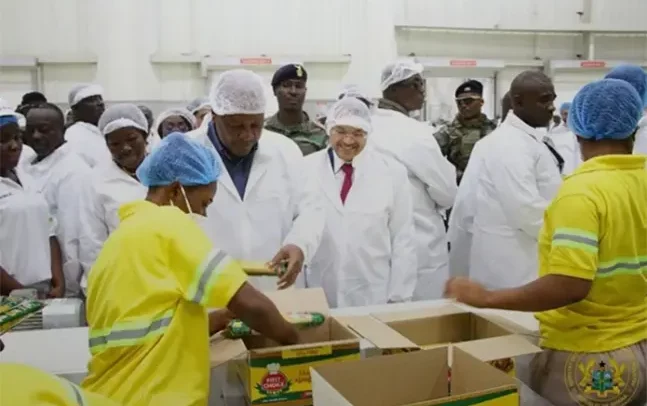
President Mahama and officials of Olam Agri touring the pasta factory
President John Dramani Mahama has commissioned the country’s first state-of-the-art pasta manufacturing factory, describing the facility as a major step toward strengthening local manufacturing, creating jobs and reducing Ghana’s reliance on imported food products.
The new plant, established by Olam Agri, is designed around a high-performance production line that ensures consistent quality while reducing power and water consumption.
The facility is expected to increase pasta production in the country, make the product more affordable for consumers and help retain more value within the local economy.
Speaking at the commissioning ceremony, President Mahama said the project represents a shift in the nation’s economic direction toward local production and industrial growth.
According to him, Ghana has the raw materials, markets and human resources to produce many of the goods it consumes, yet the country often exports raw materials and imports finished products at higher costs.
He explained that initiatives such as the pasta manufacturing facility demonstrate a deliberate effort to reduce dependence on imports while promoting domestic production.
For decades, he noted, Ghana has relied heavily on imported processed foods, a situation that increases the import bill, places pressure on the cedi and limits job opportunities for the youth.
President Mahama also highlighted the long-standing presence of Olam Agri in Ghana, noting that the company has operated in the country for about 32 years and has expanded from commodity trading into agro-processing and food manufacturing, including cocoa, cashew, grains, wheat milling, biscuits production and tomato processing.
The company currently employs more than 4,500 people directly and indirectly.
He said the new factory will create employment across the supply chain, from factory operations to logistics and distribution, while reducing Ghana’s dependence on imported pasta products.
The President further revealed that scientists from the Council for Scientific and Industrial Research have developed a wheat variety capable of growing in the country, with test harvests producing between five and six tonnes per hectare.
He added that government initiatives under the Agriculture for Economic Transformation agenda aim to modernise agriculture, expand agro-processing and generate sustainable jobs for the youth.
President Mahama also noted that the facility will operate under the government’s proposed 24-hour economy initiative, allowing industries to run multiple shifts to increase productivity.
Registered companies under the programme will benefit from incentives, including duty-free importation of equipment.
Minister for Trade and Industry Elizabeth Ofosu-Adjare said the $14 million investment represents a major milestone in Ghana’s industrialisation drive.
She revealed that Ghana imported about $140 million worth of pasta between 2021 and 2024, making the country the second-largest importer of pasta on the continent.
With an annual production capacity of about 60,000 metric tonnes, she said the new factory will meet a significant portion of domestic demand while saving foreign exchange and creating jobs.
Co-Founder and Group CEO of Olam Group, Sunny Verghese, said Ghana remains a key market for the company, which operates in nearly 70 countries worldwide.
He noted that the new facility will support regional food supply and contribute to food security across West Africa.
By Janet Odei Amponsah