
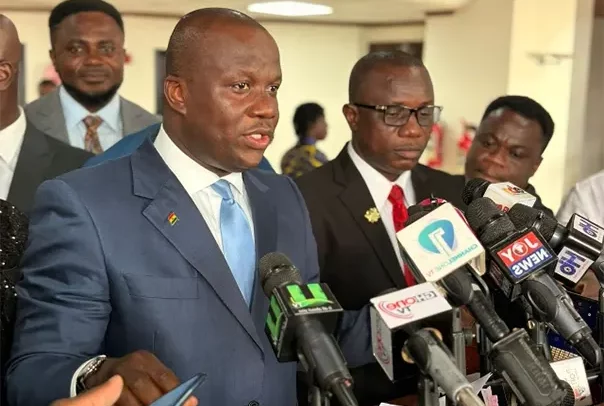
Samuel Abu Jinapor addressing the media
The Minority in Parliament has demanded urgent explanations from the government following claims that Ghana’s territory was used by the United States to launch airstrikes against ISIS targets in northern Nigeria.
The concerns were raised by the Ranking Member of Parliament’s Foreign Affairs Committee, Samuel Abu Jinapor, who said the alleged development has serious implications for Ghana’s foreign policy and national security.
Addressing journalists in Parliament yesterday, Mr. Jinapor said the Minority was reacting to comments made by the Minister for Foreign Affairs, Samuel Okudzeto Ablakwa, during a panel discussion at Chatham House in London.
According to the Minority, the Foreign Affairs Minister indicated during the discussion that the government collaborated with the United States in December 2025 to allow Ghanaian territory to be used as a base for airstrikes targeting the terrorist group ISIS in northern Nigeria.
Mr. Jinapor said Members of Parliament (MPs) and the public first heard about the alleged arrangement through the minister’s remarks abroad, raising serious questions about transparency and accountability.
“This is a matter of grave national concern with far-reaching implications for the foreign policy position of our country and the national security of Ghana,” he stated.
He questioned the legal and policy framework under which the government is said to have allowed such a military operation to be conducted from Ghanaian territory.
According to him, the Minority wants to know whether there is any formal agreement between Ghana and the United States authorising the use of Ghanaian territory to launch military attacks in another country.
Mr. Jinapor noted that the nation’s constitution requires international agreements of such nature to receive parliamentary approval before they can take effect.
“If there was any such agreement, why has the government not tabled it before Parliament for ratification or otherwise?” he asked.
The Minority also raised concerns about the possible national security implications of the alleged collaboration.
Mr. Jinapor warned that allowing Ghana to be used as a base for military action against terrorist groups could expose the country to retaliatory attacks.
“Does Ghana become a target for ISIS or other terrorist organisations? What measures have been put in place to ensure that our citizens are protected?” he queried.
Joining the call for explanations, former Defence Minister and MP for Bimbilla, Dominic Nitiwul, said previous defence cooperation agreements between Ghana and the United States did not permit the use of Ghanaian territory as a launch pad for attacks against other countries.
He explained that agreements signed in the past, including the Defence Cooperation Agreement governing the status of United States forces in Ghana, did not authorise such military operations.
“In all these agreements, at no point was the United States or any other country allowed to use the territory of Ghana as a launch pad to attack any individual, nation, group or organisation,” he said.
Mr. Nitiwul added that even the deployment of armed military aircraft in Ghana would require explicit approval from the government.
He cautioned that if the alleged arrangement was indeed authorised without a formal agreement, it could place Ghana at risk, especially at a time when terrorist groups remain active in several West African countries.
The former Defence Minister noted that extremist groups currently operate in countries such as Nigeria, Mali, Burkina Faso and Togo, making it critical for Ghana to avoid actions that could draw unwanted attention from such organisations.
The Minority therefore called on the Foreign Affairs Minister to appear before Parliament immediately to brief the House on the circumstances surrounding the alleged collaboration with the United States.
They also want the government to provide assurances that Ghana has not been unnecessarily exposed to security threats as a result of the reported military operation.
By Ernest Kofi Adu, Parliament House