
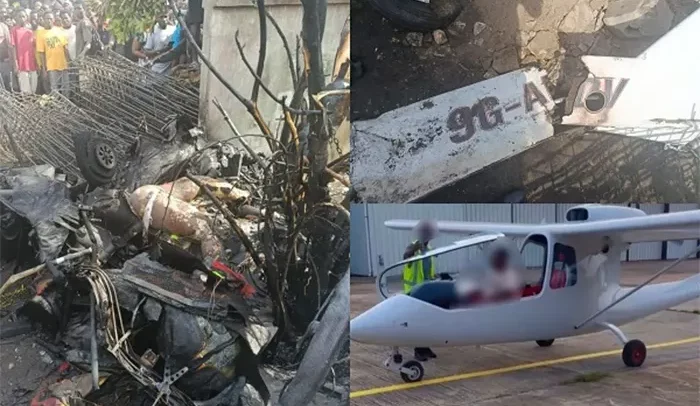
THE AIRCRAFT Accident and Incident Investigation and Prevention Bureau (AIB Ghana) has revealed that the microlight aircraft most likely suffered an engine failure caused by overheating resulting in the crash that occurred in Tema on March 16, 2026.
The investigation, led by Capt. Paul Forjoe, found that the aircraft, registered 9G-ADV, did not make a distress call or declare an emergency before the crash.
The report also noted that the engine failed at an altitude too low for the pilot to find a suitable safe landing area. AIB Ghana further stated that Air Traffic Control failed to notify the Bureau of the accident, contrary to Section 22(1)(c) of the AIB Ghana Act 1028 of 2020.
Other findings that was revealed were the fact that the aircraft performed a short flight (13 minutes) at Ho (DGAH) with a friend in the Pilot’s seat. Upon landing, a witness account of white smoke emanating from the aircraft engine was not addressed. The subsequent flight which resulted in the aircraft’s return to DGAH (Accra International Airport) due to engine overheating was also not properly attended to.
Following the limited inspection performed on the engine, the Pilot splashed water onto the engine. He then proceeded with the third flight with his brother in the pilot.
The investigation determined that since the test flight permit number ADV 235 and ferry flight permit number ADV 236 issued by GCAA authorized 9G-ADV to only perform a test flight from DGAA to DGAA and a ferry flight to DGAH, the short flight at DGAH and the intended flights from DGAH to DGAA were not authorized flights.
The investigation noted that during pre-flight operations, transit checks, and pre-departure checks and during the flight from DGAH to DGAA, the Pilot engaged in the non-operational use of his personal cell phone at different periods.
Capt. Paul Forjoe further added that the Pilot’s personal texting activities were a possible source of distraction and interruptions, adding, these distractions coupled with his lack of full access to the instruments and switches due to his seating position would have been a challenge to his ability to perform jetly.
“It is therefore possible that the Pilot’s non-operational use of his Portable Electronic Device (PED) and seating position contributed to the lack of awareness of the developing seriousness of the engine problem,” he said.
Capt. Paul Forjoe in the recommendation indicated that the Ghana Civil Aviation Authority (GCAA) should review its oversight of General Aviation aircraft operations and ensure that approved maintenance providers’ details are properly documented by the Authority as part of its records register to enhance safety in General Aviation operations.
He further indicated that GCAA should consider establishing a procedure to advise Air Traffic Control (ATC) and the Ghana Airports Company Limited (GACL) on flight permits issued to Ghanaian-registered General Aviation aircraft, including privately owned aircraft.
He said this will provide information on the conditions attached to flight permits and enable ATC and airport managers to monitor and ensure compliance with aviation safety requirements.
“Air Traffic Control (ATC) should ensure that all staff are fully aware of the requirements under the Aircraft Accident and Incident Investigation and Prevention Bureau Act, 2020 (Act 1028), particularly Section 22(1)(c), which mandates Air Traffic Controllers to immediately notify AIB Ghana of any aircraft accident using the fastest available means of communication.
This is intended to enable the Bureau to respond promptly for the preservation of evidence and the prevention of future occurrences.
Aircraft operators, including General Aviation operators, must continuously adhere to and comply with all conditions attached to permits or authorisations granted by the regulator in order to promote aviation safety,” he said.
BY Prince Fiifi Yorke