
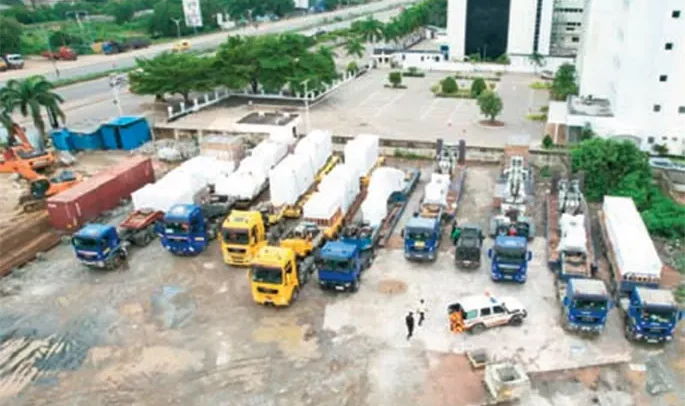
The fleet of equipment
Indigenous mining company, Damang Gold Mine Limited, has begun a large-scale equipment procurement programme backed by a $250 million investment, in a move set to significantly expand production capacity and operational efficiency at its mining site.
The company, a subsidiary of Dzata Holdings Limited and owned by mining entrepreneur Ibrahim Mahama, described the capital injection as one of the largest by a wholly Ghanaian-owned operator in the country’s large-scale mining sector in recent years.
The first tranche of equipment — 52 heavy-duty machines — is currently being transported to the mine in the Western Region. The delivery marks the start of a phased transformation of Damang’s production infrastructure, with additional equipment expected to arrive in the coming months.
Fleet Built for High-Volume Open-Pit Operations
The new fleet was selected to support intensive open-pit mining and improve material movement across the site. It includes seven Liebherr excavators, 15 Caterpillar 395 excavators, and 30 Caterpillar 777 triple dump trucks. All three models are widely used in global mining for their durability, load capacity, and efficiency in large-scale extraction.
Industry analysts say the combination of high-performance excavators and haulage trucks is standard in high-output mines where continuous ore extraction, waste removal, and rapid material transport are critical to meeting production targets.
Phased Rollout To Maintain Continuity
Damang Gold Mine Limited said the remaining equipment will be delivered in subsequent tranches. The phased approach is designed to ensure operational continuity while the new machinery is integrated into existing systems. It will also allow time for workforce training, equipment calibration, and alignment of pit operations to limit downtime.
Once fully deployed, the expanded fleet is expected to raise overall throughput, improve cycle times, reduce operational bottlenecks, and enhance ore recovery rates. Mining engineers note that haulage efficiency is a key determinant of productivity in open-pit mining, and the addition of high-capacity trucks can lift output substantially when properly integrated.
Jobs and Local Supply Chain Impact
Beyond production gains, the expansion is projected to create direct and indirect employment. The company will require additional skilled operators, maintenance technicians, mechanical engineers, safety officers, and logistics personnel to run and service the new fleet.
Local supply chains are also expected to benefit. Demand is set to increase for fuel, tyres, spare parts, and equipment servicing as the mine scales up. In surrounding communities, the investment could stimulate economic activity through subcontracting, transport services, and other ancillary businesses.
Shifting Landscape for Indigenous Mining
The investment signals growing capacity among Ghanaian firms to compete in capital-intensive, large-scale mining — a space historically dominated by foreign multinationals. For Dzata Holdings Limited, the project marks a deeper push into the extractive sector, reinforcing its role in Ghana’s industrial and resource development.
Analysts say the development reflects rising confidence in local ownership structures and a gradual move toward Ghanaian-led participation in strategic mineral assets. It also points to greater vertical integration, with indigenous companies shifting from service provision to direct resource extraction and production ownership.
The move into full-scale operations is underpinned by experience from Engineers and Planners Ltd, a leading indigenous contractor with over 30 years in mining support services, civil engineering, and equipment operations.
That technical background is expected to provide a foundation for cost control, equipment utilization, and operational discipline as Damang transitions from contracting to ownership and production management.
Broader Sector Implications
The $250 million commitment carries wider implications for Ghana’s mining industry. First, it shows indigenous firms can mobilize significant capital for industrial-scale investments without relying solely on foreign partners.
Second, it demonstrates a trend toward Ghanaian companies taking direct control of producing assets. Third, it may prompt existing operators — local and foreign — to modernize fleets and adopt more efficient systems to stay competitive.
With global demand for gold remaining strong, the addition of high-capacity excavators and haul trucks positions Damang to scale volumes and improve cost efficiency. The investment also aligns with national efforts to increase local value retention in the mining sector.
A Test for Indigenous Capacity
The arrival of the first 52 machines is more than an equipment upgrade; it represents a strategic repositioning of Ghanaian ownership in a key economic sector.
Management says the modernized fleet and clear expansion strategy place Damang Gold Mine Limited at the forefront of a new era in indigenous mining.
As additional equipment arrives and operations ramp up, the project will serve as a critical test of Ghanaian capacity to manage, scale, and sustain world-class mining operations. If successful, it could set a precedent for greater local participation in large-scale mineral production and influence how capital is deployed across the industry.
The company has not disclosed specific production targets following the upgrade, but indicated that the new machinery will support “a substantial increase in mining output” once fully integrated.
A Daily Guide Report