
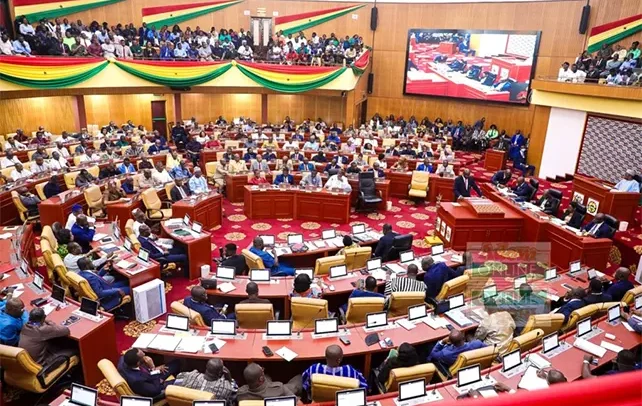
Parliament yesterday passed the Ghana Cocoa Board Bill, 2026, under a certificate of urgency after a majority decision endorsed the Finance Committee’s recommendation that the legislation be expedited ahead of the start of the 2026/2027 cocoa season.
The Bill establishes a new legal framework for the Ghana Cocoa Board (COCOBOD), empowering it to regulate, oversee and monitor activities across the cocoa value chain, support cocoa cultivation, undertake the buying, selling and export of cocoa, and promote value addition to Ghana’s cocoa industry.
The legislation was introduced in Parliament on Tuesday, July 28, 2026, by the Deputy Minister for Finance, Thomas Nyarko Ampem, and was referred to the Finance Committee to determine whether it qualified for consideration under a certificate of urgency in accordance with Article 106(13) of the 1992 Constitution and the Standing Orders of Parliament.
Presenting its report, Chairman of the Finance Committee, Isaac Adongo, said the urgency was justified because the new cocoa season and cocoa pricing window are scheduled to commence in the first week of September 2026, making it necessary for the legal framework to be in place before then.
The Committee noted that the new law would provide the statutory basis for key government reforms, including a new domestic financing model for cocoa purchases, a guaranteed payment of 70 percent of the Free-on-Board (FOB) price to cocoa farmers, and a policy reserving 50 percent of Ghana’s cocoa production for local processors.
According to the Committee, the Bill will enable COCOBOD to raise funds through commercial paper and other domestic financing instruments, replacing the traditional dependence on foreign financing arrangements for cocoa purchases.
It said the new financing framework would strengthen investor confidence, provide legal certainty and facilitate the mobilisation of domestic capital.
The Committee further explained that guaranteeing farmers 70 percent of the FOB price in law would ensure transparency and protect producers from arbitrary changes to the pricing formula, while the allocation of half of the country’s cocoa output to local processors is expected to boost value addition, create jobs and increase export earnings from processed cocoa products.
*Minority Concerns*
However, the Minority opposed the decision to fast-track the legislation, arguing that the Bill required broader stakeholder consultation and more detailed scrutiny before passage.
During the debate, Minority members maintained that Parliament had been presented with a fresh draft Bill despite extensive work on an earlier version laid in 2025.
They argued that stakeholders needed sufficient time to study the new provisions before Parliament enacted legislation governing one of the country’s most strategic sectors.
The Minority also questioned whether adequate stakeholder consultations had been conducted, warning that rushing the Bill through Parliament could attract public criticism and undermine confidence in the legislative process.
*Majority Defence*
Defending the urgency of the Bill, the Majority Leader, Mahama Ayariga, told the House that many of the proposed amendments had already been thoroughly examined during a joint consideration involving the Finance, Economy and Agriculture Committees.
He said concerns raised by stakeholders had been incorporated into the revised draft before it was presented to Parliament.
By Ernest Kofi Adu, Parliament House