
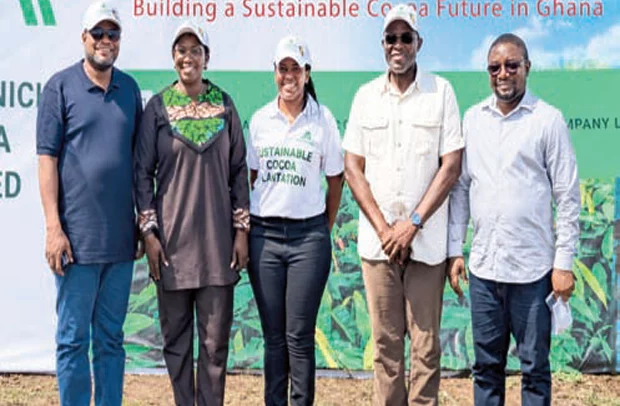
From Left: Thomas Worlanyo Tsekpo, Jean-Marie Formadi, Davida Pappoe and Sebastine Deh
Afarinick Company Limited (ACL) has distributed over 400,000 improved cocoa seedlings free of charge to farmers across the Volta Region.
The large-scale seedling distribution is aimed at accelerating cocoa cultivation, improving farmer livelihoods and positioning the region as the country’s next cocoa production frontier.
The free distribution of seedlings also formed part of Afarinick’s broader commitment to supporting farmers with access to high-quality planting materials while driving sustainable cocoa expansion across suitable growing areas in the Volta Region and beyond.
The exercise held at Afarinick’s flagship cocoa project in Kpando, where the company has established a 2,000-acre sustainable commercial cocoa plantation, brought together hundreds of cocoa farmers, traditional authorities, political leaders, agricultural stakeholders and representatives from the cocoa industry.
Speaking at the event, Member of Parliament (MP) for Kpando, Sebastian Fred Deh, described the intervention as transformative, noting that the distribution of seedlings and the establishment of large-scale cocoa infrastructure would empower farmers and contribute significantly to the Volta Region’s economic development.
MP for Hohoe Thomas Worlanyo Tsekpo and Biakoye MP, Jean-Marie Formadi also reaffirmed their commitment to supporting cocoa expansion efforts within their constituencies, stressing the potential of cocoa farming to job creation, income generation and rural development.
The 400,000 seedlings distributed were produced from improved cocoa varieties designed to deliver higher yields, better disease tolerance and greater resilience to changing climatic conditions.
Programmes Manager of Afarinick Company Limited, Davida Pappoe, explained that the free distribution of improved cocoa seedlings forms part of the company’s Corporate Social Responsibility (CSR).
She noted that through investments in seedling production and the provision of quality planting materials to farmers, Afarinick aims to support cocoa expansion efforts, enhance farm productivity and create sustainable livelihood opportunities for rural households, particularly in emerging cocoa-growing areas such as the Volta Region.
She noted that the seedlings were raised in Afarinick’s state-of-the-art cocoa nursery in Kpando, which has the capacity to produce more than two million improved cocoa seedlings annually.
Afarinick also acknowledged the invaluable support of the Seed Production Division (SPD) of the Ghana Cocoa Board (COCOBOD), which supplied the improved cocoa pods used in producing the seedlings distributed to farmers.
For many farmers, the free seedlings represented a valuable opportunity to establish or expand cocoa farms without the burden of acquiring planting materials.
A Daily Guide Report