
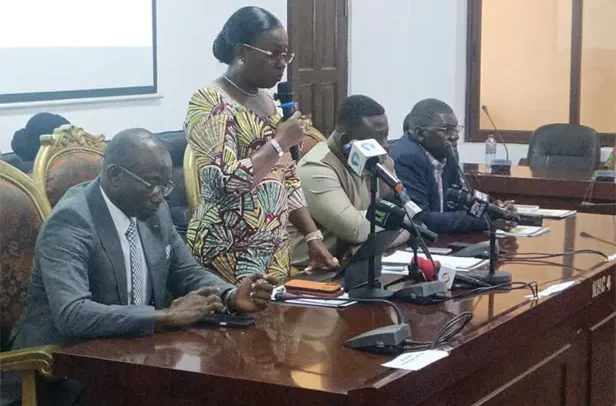
Adjoa Obuobia Darko-Opoku addressing the chiefs
The Ghana Medical Trust Fund (GMTF), popularly known as Mahama Cares, has appealed to the National House of Chiefs to support government’s efforts to expand access to specialised healthcare for Ghanaians suffering from chronic non-communicable diseases (NCDs).
The appeal was made during a courtesy call on the President of the National House of Chiefs, Ogyeahoho Yaw Gyebi II, and members of the House by the Board and Management of the Ghana Medical Trust Fund.
Leading the delegation, Board Chairperson, Adjoa Obuobia Darko-Opoku, said traditional leaders remain indispensable partners in ensuring that the benefits of the Trust Fund reach every community across the country.
The delegation included representatives of the Ministry of Health led by Dr. Hafiz Adams, as well as the Ashanti Regional Minister, Frank Amoakohene, and the Bono East Regional Minister, Francis Owusu Antwi, who represented Ghana’s 16 Regional Ministers at the engagement.
Addressing the chiefs, Ms. Darko-Opoku said the increasing prevalence of chronic diseases, including kidney failure, cancer, stroke, cardiovascular diseases, diabetes and sickle cell disease, continues to impose severe financial hardship on many Ghanaian families.
She explained that President John Dramani Mahama established the Ghana Medical Trust Fund to ensure that no Ghanaian is denied access to life-saving specialised healthcare because of financial constraints.
According to her, the Fund is built on four strategic pillars: providing financial support for patients, investing in critical medical equipment and healthcare infrastructure, training specialist healthcare professionals, and supporting medical research.
She disclosed that following the passage of the Ghana Medical Trust Fund Act, 2025 (Act 1144), the Fund has established its Secretariat and Board, undertaken nationwide needs assessments in major hospitals, and deployed a digital platform to process patient applications and claims efficiently.
She added that the Trust Fund is facilitating the establishment of three modern cardiac catheterisation laboratories (Cath Labs) at Korle Bu Teaching Hospital, Komfo Anokye Teaching Hospital and Tamale Teaching Hospital to improve specialised cardiac care.
Ms. Darko-Opoku stressed that government alone cannot achieve the objectives of the initiative and appealed to chiefs to help educate their communities about the Fund, encourage early health-seeking behaviour and support nationwide public awareness campaigns.
Representing the Minister for Health, Dr. Hafiz Adams said the ministry recognises the critical role traditional authorities play in national development and healthcare delivery.
He explained that government’s healthcare financing strategy is based on three key interventions—Free Primary Healthcare, the National Health Insurance Scheme (NHIS) and the Ghana Medical Trust Fund, which focuses on financing specialised treatments that remain beyond the reach of many Ghanaian families.
He urged chiefs to use their influence to promote awareness of the Fund, encourage early diagnosis and ensure that vulnerable persons benefit from the intervention.
Speaking on behalf of the country’s 16 Regional Ministers, Dr. Frank Amoakohene reaffirmed the commitment of regional ministers to supporting the decentralisation of the Ghana Medical Trust Fund through the local government system.
He noted that non-communicable diseases account for about 75 percent of deaths globally and approximately 45 percent of deaths recorded in hospitals in Ghana, making sustainable healthcare financing a national priority.
Drawing from his experience as a medical practitioner, Dr. Amoakohene said he had witnessed many families sell properties and other valuable assets to finance dialysis and other life-saving treatments.
He said the Trust Fund was established to bridge that gap by supporting patients suffering from illnesses such as cancer, kidney disease, diabetes, hypertension and neurological disorders that are not adequately covered under the NHIS.
FROM David Afum, Kumasi