
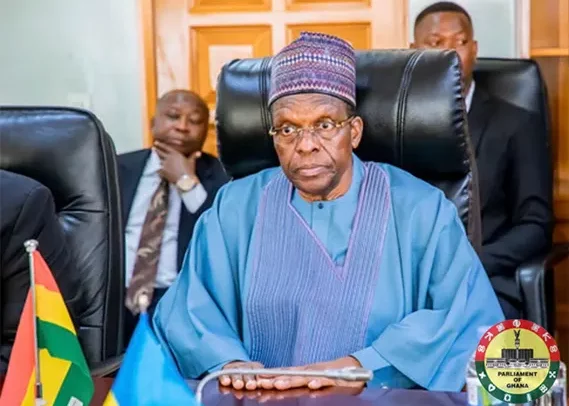
Alban S.K. Bagbin
The Speaker of Parliament, Alban Sumana Kingsford Bagbin, has disclosed that Africa loses approximately $88.6 billion annually to corruption and illicit financial flows.
Mr. Bagbin, who is also Chairman of the African Parliamentarians’ Network Against Corruption (APNAC Africa), warned that the growing menace continued to undermine democratic governance, weaken institutions and erode public trust across the continent.
Speaking at the opening of the Second Executive Board Meeting of APNAC Africa in Kigali, Rwanda, Speaker Bagbin described the gathering as a defining moment in Africa’s pursuit of a corruption-free future anchored on good governance.
“We meet today at a defining moment in our bid for a corruption-free Africa which thrives in good governance,” he stated.
The meeting, hosted by Rwanda, brought together parliamentarians, anti-corruption advocates and international partners to deliberate on strategies aimed at strengthening anti-corruption efforts across the continent.
Citing figures from the African Union and the United Nations Economic Commission for Africa, Mr. Bagbin said the billions lost annually to corruption represented nearly 3.7 percent of Africa’s Gross Domestic Product (GDP).
According to him, the resources lost through corruption could otherwise be channelled into healthcare, education, infrastructure and social protection programmes.
“Corruption continues to fuel inequality, poverty, insecurity, poor service delivery and public disillusionment, particularly among the youth,” he stressed.
The APNAC Africa Chairman also warned of emerging threats posed by the misuse of artificial intelligence and digital technologies – cyber-enabled corruption and sophisticated transnational financial crimes.
He called for innovative, coordinated and future-oriented responses to address the evolving nature of corruption on the continent.
Despite the challenges, Mr. Bagbin identified several African countries as examples of effective anti-corruption governance.
He commended Rwanda, Botswana, Seychelles, Mauritius and Ghana for demonstrating that strong political will, institutional discipline, digitisation of public services and effective monitoring systems could significantly reduce corruption and restore public confidence.
“These countries have shown what is possible when leadership is committed to accountability and reform,” he said.
He paid special tribute to Rwanda for what he described as visionary leadership and institutional reforms that had strengthened accountability and national transformation.
Mr. Bagbin reminded parliamentarians of their responsibility as custodians of public trust, urging them to intensify efforts to promote transparency and accountability in governance.
“We are not merely lawmakers. We are custodians of public trust. We are representatives of the aspirations of millions of Africans who expect integrity in public leadership and accountability in governance,” he declared.
He noted that since assuming office as President of APNAC Africa during the network’s 9th Biennial General Meeting in Accra in November 2025, the leadership had adopted a vision of building a stronger and more impactful continental parliamentary movement against corruption.
Mr. Bagbin further urged members to use the upcoming African Anti-Corruption Day on July 11 as a platform for advocacy, parliamentary action, youth engagement and renewed commitment to integrity.
He also expressed appreciation to the government and people of Rwanda, APNAC Africa board members and international partners, particularly the Global Organisation of Parliamentarians Against Corruption (GOPAC), for supporting the anti-corruption agenda across Africa.
By Ernest Kofi Adu