
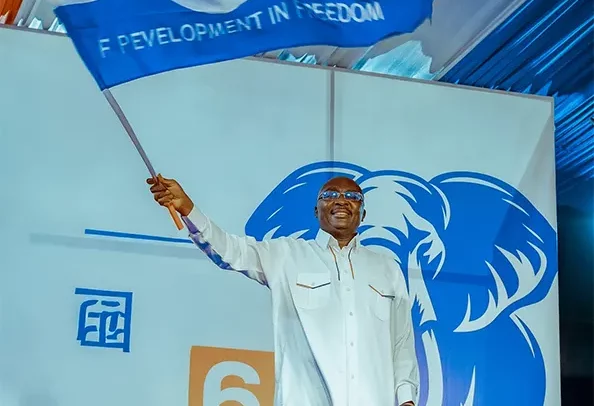
Dr. Bawumia waving the party flag in victory
Dr. Mahamudu Bawumia’s victory in the New Patriotic Party’s (NPP) presidential primary, with 56.48 percent of the votes, has settled the immediate question of leadership within the opposition.
In an expanded electoral college, the margin is not marginal. It confers clear procedural legitimacy, moral authority to steer party reconciliation, and firm control over the NPP’s forward narrative.
Yet, it is not a blank cheque. Nearly 43.5 percent of delegates voted for alternative candidates, a bloc too significant to dismiss in a mass delegate system. The verdict from the primary is therefore a strong mandate, but one conditioned on unity.
With the National Democratic Congress (NDC) currently in government and President John Dramani Mahama no longer on the electoral stage, the political terrain ahead of 2028 is fundamentally different.
Dr. Bawumia now emerges as the undisputed face of opposition politics. His victory allows him to act as the principal counter-voice to the governing party without appearing internally weakened.
At the same time, it places a premium on discipline. Any prolonged infighting within the NPP would hand the NDC an easy line of attack: that the opposition is still sorting itself out while the country needs focus and direction.
The first test of leadership will come quickly. Over the next 90 days, reconciliation must move from courtesy to strategy. The traditional approach, such as token appointments, symbolic handshakes, and carefully choreographed unity photos, will not suffice.
What is required is structured engagement with the delegate networks of losing aspirants, visible inclusion of their key operatives, and unambiguous signals that this will not be a winner-takes-all project. Failure to do so risks silent sabotage, low enthusiasm in strongholds, and protest abstentions when it matters most. Unity, in this moment, must be engineered rather than assumed.
Beyond internal management lies a more demanding challenge: narrative reset. The primary campaign rewarded party loyalty, institutional memory, and intellectual consistency. The general election will reward something else entirely, which is empathy, clarity on livelihoods, and a human story that resonates beyond macroeconomic explanations.
Dr. Bawumia has long been perceived, fairly or not, as a cerebral technocrat. As opposition leader, he must now shed the language of internal party contests and adopt the tone of a national leader-in-waiting.
That means less PowerPoint and more people; fewer justifications of past decisions and more acknowledgements of lived hardship. Crucially, this pivot cannot wait until 2027. It must begin now.
The primary result also offers insight into the NPP’s base. Delegates voted for continuity, but with conditions. The outcome suggests acceptance of the party’s broad narrative as a framework, a desire for stability after internal turbulence, and trust in institutional succession.
At the same time, it reflects anxiety about electability in 2028, fatigue with explanations that centre on economic pain without visible relief, and a demand for tangible next-phase solutions. In essence, the base voted for experience, not against change.
Equally important is the message sent by the expanded electoral college. Grassroots delegates asserted their relevance. Retail politics mattered. Long-term relationships proved more valuable than last-minute endorsements, and consistent constituency-level visibility paid dividends. For the Bawumia campaign, this is both validation and warning: ignore the grassroots at your peril.
Looking Ahead
Looking ahead to 2028, the general election is shaping up as a referendum on credibility rather than intelligence. Dr. Bawumia’s biggest hurdle will not be competence, which few dispute, but belief.
Voters will ask whether he truly understands their hardship, whether they can trust him to act differently, and why they should believe the next four years will be better than the NDC’s. Data alone will not win this contest. Trust will.
The National Democratic Congress’ strategy is already predictable. The ruling party is likely to frame Dr. Bawumia as continuity of pain, an architect without accountability, brilliant but detached. The most effective counter will not be defensiveness. It will be selective ownership such as clear admission of what did not work under the Nana Akufo-Addo’s administration, coupled with a bold, forward-looking break in tone and priorities. Defensive campaigns rarely win swing voters.
Opposition status both helps and constrains Dr. Bawumia. On the positive side, he can now define himself forward, speak as a citizen advocate rather than a state actor, and advance reform ideas without bureaucratic excuses.
On the other hand, his record as Vice President remains fair game. The governing party will insist that he had eight years to act. Navigating this tension will require discipline: accepting responsibility where it builds trust, and distinguishing personal intent from structural limitations where necessary.
For the NDC, the absence of Mr. Mahama introduces its own uncertainties. While holding power confers advantages, the loss of a familiar electoral figure means a new candidate must be nationalised quickly. Internal primaries could expose factional fault lines and delay messaging. Power, history suggests, does not automatically guarantee cohesion.
If the NPP misreads this moment, which is treating the primary win as vindication of the past, a technocratic endorsement, or a licence to sideline rivals, the risks are clear. Youth apathy could deepen, floating voters may drift, and 2028 could become an uphill battle regardless of campaign machinery.
What, then, does success look like from here? Over the next 12 to 18 months, three signals will matter. First, inclusive campaign architecture: are former rivals visibly empowered? Second, message evolution: does the language shift from defence to hope? Third, policy specificity on livelihoods such as jobs, cost of living, credit access, and small business revival.
If these align, the NPP enters 2028 competitive. If not, this 56.48 percent becomes a strong internal victory with weak national translation.
The bottom line is simple. Dr. Bawumia has won his party. He must now convince the country that he can win the future. The primary is over. The harder election has just begun.
By Ernest Kofi Adu