
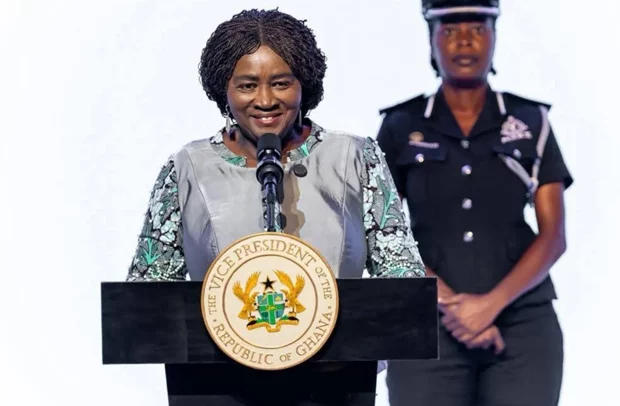
Prof. Naana Jane Opoku-Agyemang
African governments have been urged to strengthen development finance institutions and pursue long and medium-term policies to support regional projects in order to deepen integration as well as economic transformation across the continent.
Speaking at the 2026 Africa Prosperity Dialogues (APD) in Accra, Vice President Prof. Naana Jane Opoku-Agyemang said Africa’s development ambitions can only be realised through coordinated policies, strong institutions and cross-border cooperation that reflect the continent’s collective potential.
She emphasised the need for African countries to continue integrating their borders in order to address fragmented borders, which she describes as a major obstacle for Africa’s growth.
“Our borders should connect us, not divide us. African governments have to re-examine how borders are managed in order to promote trade, mobility and shared prosperity,” she stated, noting that the African Continental Free Trade Area (AfCFTA) represents opportunity to deepen intra-African trade, investment and economic cooperation.
She also described the AfCFTA as the world’s largest free trade area given the number of participating countries, which offers access to a market of 1.3 billion people and provide an opportunity for Africa to shape its future.
She stated, “The idea of a reset is to move Africa from dependency to self-reliance, from fragmentation to integration, and from exporting potential to building prosperity at home. The dream of Africa as a single integrated economic space remains unfinished.”
The Vice President, who highlighted the role of small and medium-sized enterprises (SMEs) in creating jobs across the continent, noted that SMEs generate more than 80 per cent of employment in Africa and contribute significantly to GDP, despite operating under difficult conditions.
She also mentioned that women make up nearly half of the continent’s workforce and play a dominant role in micro and small enterprises. Africa’s youth, who account for more than 60 per cent of the population, were described as a powerful force behind innovation, technology and the creative industries.
Prof. Opoku-Agyemang, however, indicated that despite the vast entrepreneurial skills, these entrepreneurial potentials are yet to be fully reflected in cross-border trade and investment.
She warned that without decisive action, many African economies risk remaining trapped in low-productivity models that rely on exporting raw materials while importing finished goods, a trend that often drives talented young Africans to seek opportunities elsewhere.
“This trajectory is neither inevitable nor acceptable,” she said, calling for stronger coordination, clearer industrial strategies and sustained investments in infrastructure, connectivity, innovation and skills development to support priority sectors.
Prof. Opoku-Agyemang said strong institutions remain essential to sustaining Africa’s economic progress, while highlighting the country’s contribution to the continent through initiatives such as the 24-Hour Economy that aims to increase productivity in all sectors of the economy.
She added that the government’s ‘Big Push’ infrastructure development programme is laying the foundation for increased trade and industrial growth, while aligning Ghana’s national priorities with those of ECOWAS and the African Union.
“Integration does not mean erasing national sovereignty but organising it to serve common economic goals. It is about enabling an entrepreneur or manufacturer, whether in Accra, Kigali or elsewhere, to see Africa not as a fragmented abstraction but as one connected market with vast opportunities,” she said, expressing hope that the outcomes of the dialogue would translate into concrete actions and measurable results.
Africa Prosperity Dialogues 2026, which started on Wednesday, February 4 and ends on Friday, February 6, is held under the theme “Empowering SMEs, Women and Youth in Africa’s Single Market: Innovate. Collaborate. Trade.”
By Ebenezer K. Amponsah