
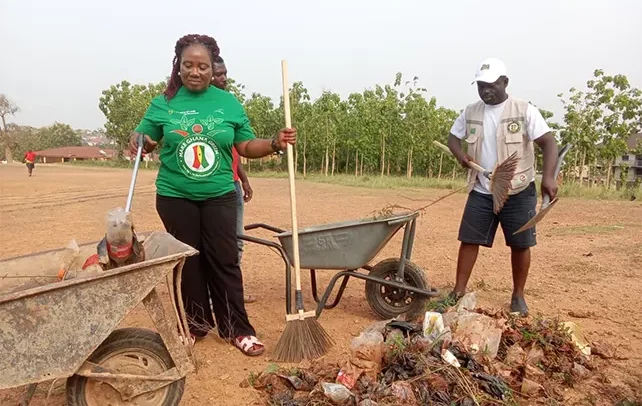
Grace Agyemang Asamoah and a journalist from Ezra TV/FM clearing some refuse
The District Chief Executive (DCE) for Atwima Kwanwoma, Grace Agyemang Asamoah, has intensified calls on residents to embrace regular clean-up exercises and take collective responsibility for keeping their communities clean.
Madam Asamoah made the appeal when she joined the Assembly Member and some residents of Ampabame I to undertake a clean-up exercise ahead of the district’s 69th Independence Day celebration scheduled to be held in the community.
The National Sanitation Day, normally observed on the first Saturday of every month, was held on February 28, 2026, as part of preparations towards the Independence Day event.
Speaking to the media after the exercise, the DCE stressed that sanitation must not be treated as a symbolic monthly activity but as a daily civic duty.
“Sanitation is key to preventing diseases and ensuring a healthy population. We must cultivate the habit of cleaning our surroundings at all times and not wait for National Sanitation Day,” she stated.
She disclosed that upon arrival at the school park designated for the Independence Day celebration, the team encountered plastic waste and other refuse scattered around the field, posing health risks, particularly to pupils. However, the area was thoroughly cleaned and made ready for the upcoming national event.
Mrs. Asamoah expressed concern about the low turnout of residents, noting that although prior notice had been given by the Assembly Member, only a few people participated while many others went about their normal duties.
She encouraged residents across the district to show greater commitment in subsequent exercises, describing the sanitation initiative as a shared responsibility that requires full community participation.
According to her, since assuming office, she has decentralised the sanitation exercise to all electoral areas within the district to ensure inclusiveness. She revealed that Assembly Members have been provided with tools such as brooms, wheelbarrows, rakes and gloves to organise clean-up activities in their respective communities.
“When I assumed office, I realised that holding the exercise in only one community left others behind. So we ensured that all electoral areas are adequately equipped to observe the day effectively,” she explained, expressing optimism that participation will improve in the coming months.
She commended the Assembly staff, participating residents and the media for their support, and urged the public to back the government of President John Dramani Mahama in sustaining the National Sanitation Day initiative.
The District Environmental Director, Ernest Boakye, also noted that the reintroduction of the sanitation exercise has significantly improved waste management in the district.
He explained that in the past, Assembly Members had to rent cleaning tools at their own expense, which discouraged some from fully participating. However, under the leadership of Mrs. Asamoah, popularly known as “Obaatanpa,” each electoral area now has its own set of tools, making the exercise more effective.
He added that communities such as Ampabame I, Asaago, Akyeremade, Trede and Sabin Akrofuom, which previously struggled with indiscriminate dumping of refuse, have benefited from the provision of refuse containers. The Assembly ensures that the containers are regularly emptied, leading to a decline in sanitation-related complaints and diseases.
The Assembly Member for Ampabame I, Rudolf Asuala, thanked the DCE, Assembly staff and journalists for supporting the exercise in his electoral area.
He commended the DCE for easing the financial burden on Assembly Members by providing sanitation tools, and appealed to chiefs, opinion leaders and residents to actively participate in future exercises.
“Malaria and cholera do not recognise political affiliations. Whether National Democratic Congress (NDC), New Patriotic Party (NPP) or Convention People’s Party (CPP), we all benefit from a clean environment. Let us support the National Sanitation Day for the good of our communities,” he urged.
FROM David Afum, Ampabame I