
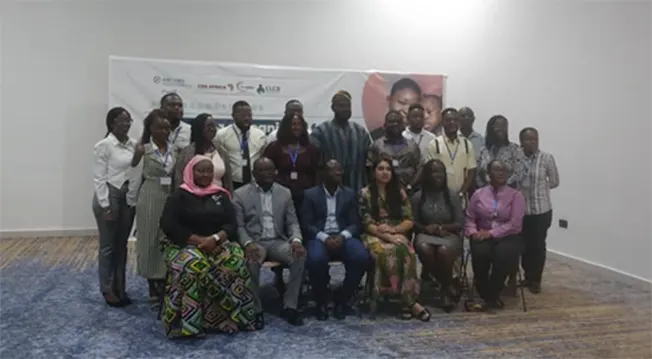
Participants at the workshop
The Africa Centre for Democracy and Socio-economic Development (CDS-Africa), in partnership with the Center for Learning and Childhood Development (CLCD) and Songtaba, has held a workshop aimed at addressing the burden of unpaid care work on women, particularly caregivers of children with disabilities, in Accra.
In an interview with the Director of the CLCD, Dr. Kwame Sakyi explained that the ARISE framework which stands for Advocacy, Reform, Inclusion, Support and Empowerment, was developed to reduce the burden on caregivers of children living with disabilities as well as Children with Developmental Disabilities (CWDD).
He mentioned that the framework advocates prioritising disability issues, as well as reforming the disability fund to support families, while fully implementing inclusive education policies to provide support systems for families, and economically empowering caregivers. He revealed that research conducted by the centre shows that about 60 per cent of families experience relationship breakdowns following the diagnosis of a child with disability, with caregiving responsibilities often left to the women.
He added that only nine per cent of caregivers receive any form of support, while just three per cent receive assistance from the government, despite the overwhelming need for state intervention.
Addressing inclusive education, he acknowledged government efforts but noted that challenges remain, including inadequate resources and limited acceptance of children with disabilities in many schools.
“We want every school to be designed in a way that children with disabilities can attend and thrive,” he said.
Executive Director of Songtaba, Lamnatu Adam, mentioned that data shows that women spend a significant amount of their time on unpaid care work, which reduces their economic power.
She noted that childcare responsibilities, especially for children who are not in school, largely fall on women.
“In Ghana, formal education begins around age four. This raises questions about what happens to children from zero to four years, particularly in rural communities where there are no nurseries. These children are often left with women, which reduces the time they would have spent doing productive work,” she said.
She stated that the situation becomes more challenging when a child has developmental disabilities, placing caregivers, mostly women, under severe economic and emotional strain.
Ms. Adam stressed the need to recognise caregiving as work, noting that the invisible labour parents perform has serious implications on their wellbeing.
“If all children, including those with disabilities, are in school, even a woman who is not formally employed would have time to rest, sleep and engage in productive activities,” she said.
By Florence Asamoah Adom & Vera Owusu Sarpong