
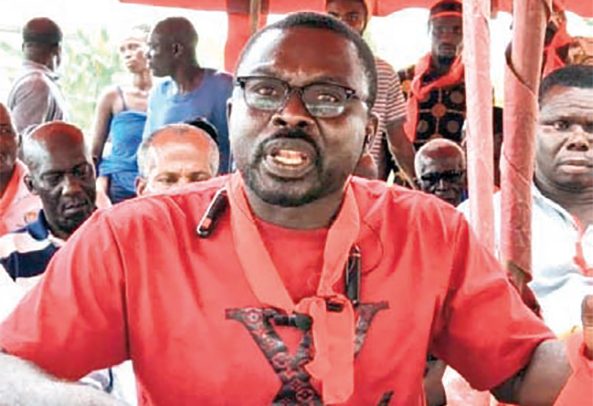
Some of the aggrieved rubber farmers
Rubber farmers in the Western Region have condemned a proposed government decision to restrict the exportation of raw rubber, calling for broad consultations with farmers and other stakeholders before the policy is implemented.
The farmers, operating under the Western Rubber Farmers Association (WRUFA), together with other concerned farmers and traders within the rubber value chain, say they are disappointed by what they describe as the government’s sudden decision.
According to them, it is unclear why restrictions on the export of raw rubber are being considered without the completion of earlier agreed stakeholder consultations.
Addressing a press conference on Saturday, the Financial Secretary of WRUFA, Kingsley Kwesi Bentum, said that a few months ago the Minister of Trade, Agribusiness and Industry convened a stakeholder meeting involving processors, farmers, traders, exporters and the Tree Crop Development Authority (TCDA) to address challenges confronting the rubber industry.
He explained that during the meeting, the Minister acknowledged the complexity of the issues and emphasised the need for thorough dialogue.
“The Minister clearly stated that a second meeting would be scheduled to allow stakeholders to submit detailed proposals. However, to date, that promised meeting has not been held,” Mr. Bentum said.
He noted that stakeholders were therefore shocked to hear that government now intends to restrict the exportation of raw rubber.
“How can such a major policy decision be taken without concluding the consultation process?” he questioned.
Mr. Bentum argued that the government’s sudden move undermines transparency and fairness, and raises legitimate concerns about whether government has taken sides to the detriment of farmers.
According to him, the proposed restriction appears to favour Ghana Rubber Estates Limited (GREL) and a few processors in the region, without giving equal consideration to the concerns of farmers, traders and exporters.
He recalled that in 2016, WRUFA organised demonstrations to break what it described as the monopoly enjoyed by GREL in the region.
He said many farmers subsequently stopped supplying the company because it purchased raw rubber at very low farm-gate prices.
Mr. Bentum further alleged that GREL often delays payments to farmers, contributing to poor living conditions, while offering little in the way of incentives or livelihood support.
“On the contrary, traders and aggregators have played an essential role by offering farmers competitive farm-gate prices, financial support and access to farm inputs,” he said.
He stressed that rubber farmers have contributed significantly to the country’s agricultural sector and, therefore, deserve to be consulted on policy decisions that affect their livelihoods.
Mr. Bentum warned that if government proceeds with the planned restrictions without engaging all stakeholders and addressing farmers’ concerns, producers may stop tapping rubber altogether.
“Many farmers will consider cutting down their rubber trees and converting their farmlands to more profitable ventures,” he added.
From Emmanuel Opoku, Agona-Nkwanta