
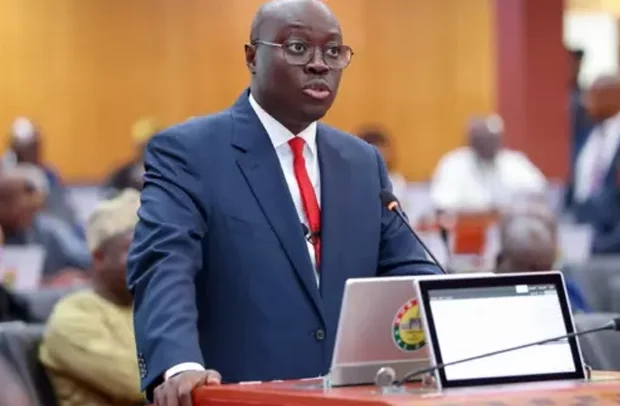
Dr. Cassiel Ato Forson
The Minister of Finance, Dr. Cassiel Ato Forson, has announced an ambitious plan by the government to build the country’s foreign exchange reserves to the equivalent of 15 months of import cover by 2028, leveraging the country’s gold resources as a central pillar of the strategy.
According to him, the policy, known as the Ghana Accelerated National Reserve Accumulation Policy (GANRAP), has received Cabinet approval and forms part of broader efforts to consolidate macroeconomic stability and strengthen the economy against external shocks.
Presenting the framework in Parliament yesterday, Dr. Forson explained that the government is deliberately moving beyond the traditional benchmark of maintaining reserves sufficient to cover three months of imports – a threshold he described as outdated in the face of increasing global financial volatility, commodity price swings, and capital flow reversals.
He stated that the new 15-month target is designed to provide a significantly stronger buffer against balance-of-payments pressures, exchange rate instability, and fiscal stress that have historically undermined the country’s economic resilience.
He pointed out that a key feature of the policy is the enhanced monetisation of Ghana’s gold resources, intimating that the Ghana Gold Board will play a leading role in mobilising foreign exchange earnings from gold purchases and exports, capitalising on strong global prices and increased domestic production.
According to the Finance Minister, gold will serve as a strategic reserve asset to accelerate accumulation while reducing reliance on volatile external borrowing.
He noted that improved fiscal consolidation, moderating inflation, and stronger external sector performance in 2025 have created a favourable environment for rebuilding buffers.
He said the implementation of GANRAP would involve close coordination with the Bank of Ghana to ensure that reserve accumulation aligns with monetary policy objectives and does not disrupt liquidity management or financial stability.
The Finance Minister justified the aggressive reserve build-up by pointing to structural vulnerabilities in the external sector, including declining crude oil output, cocoa market volatility, and exposure to geopolitical disruptions that affect trade and capital flows.
Beyond stabilisation, Dr. Forson argued that a stronger reserve position will boost investor confidence, lower sovereign risk perceptions, support exchange rate stability, and anchor long-term capital inflows needed for sustained growth.
Minority Questions Policy Direction
Reacting to the announcement, Dr. Gideon Boako, New Patriotic Party (NPP) MP for Tano North, acknowledged the importance of building adequate foreign exchange buffers but disputed suggestions that GANRAP represents a novel policy shift.
He cited the Domestic Gold Purchase Programme and the Gold-for-Resources framework implemented by the Bank of Ghana between 2021 and 2022, arguing that those initiatives had already strengthened the country’s gold holdings and contributed to currency stability.
Dr. Boako, however, questioned what he described as inconsistencies in the current strategy, pointing to the sale of portions of accumulated gold reserves while the government now seeks to expand its holdings.
According to him, Ghana’s gold reserves increased from about 8,000 ounces to more than 32,000 ounces before rising to roughly 38,000 ounces prior to some disposals.
He argued that both gold and foreign exchange reserves are complementary instruments in reinforcing monetary credibility and market confidence and called for clarity on the intended composition of reserves – whether the emphasis will be on gold, foreign exchange, or a balanced mix – and demanded details on financing arrangements supporting gold purchases under the Ghana Gold Board.
Majority Defends Strategy
On the Majority side, Isaac Adongo, NDC MP for Bolgatanga Central, defended the policy and dismissed the Minority concerns about reserve management.
He described GANRAP as a forward-looking response to the country’s historical reserve vulnerability, recalling that the country entered an International Monetary Fund programme in 2022 with reserves covering less than one month of imports.
Mr. Adongo maintained that Ghana’s gross international reserves had grown from approximately $8 billion to about $13 billion by the end of 2025 through improved foreign exchange generation and prudent management, rejecting claims that the build-up was driven by extraordinary external injections.
By Ernest Kofi Adu, Parliament House