
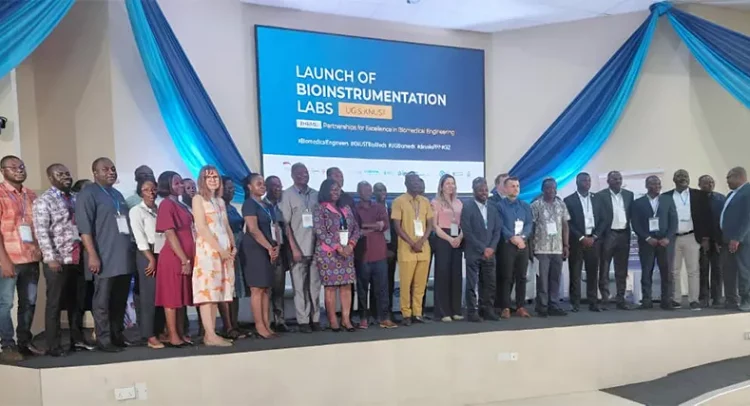
Officials in a group photograph
To close the gap between education, research, and industry in the field of Biomedical Engineering, a joint project between five private sector German and Ghanaian companies and GIZ is improving training and providing laboratory equipment for Biomedical Engineering students at the Kwame Nkrumah University of Science and Technology (KNUST) and the University of Ghana (UG).
This move will position the Biomedical Engineering (BME) students to graduate with job-ready skills that are in high demand across hospitals, manufacturing firms, and medical service providers nationwide.
Equipping the two bioinstrumentation laboratories was made possible under the “Upskilling Biomedical Engineers for Ghana” project.
Director, Allied Health, Ministry of Health, Dr. Ignatius Awinibuno, speaking on behalf of the Minister of Health, said the launch of the enhanced Bioinstrumentation Laboratories as part of the “Upskilling Biomedical Engineers for Ghana” initiative marks the strengthening of Ghana’s capacity to engineer solutions for its own healthcare challenges. It marks a strategic investment in competence, innovation, and sustainability within the country’s healthcare system.
He mentioned that, Biomedical Engineering involves the application of concepts, knowledge, and approaches of virtually all engineering disciplines to solve specific healthcare problems.
”It is now a multibillion-dollar industry globally with a market size valued at $497.6 billion in 2022 and projected to grow to $847.8 billion by 2030. It is concerned with designing and producing devices, processes, and equipment to serve millions across the globe,” he emphasised.
Healthcare today, he said, is inseparable from technology. Competent professionals who can install, maintain, calibrate, troubleshoot, and innovate around these systems are the true custodians of patient safety.
He explained that Biomedical Engineers stand at the vital intersection of engineering and medicine. Therefore, investing in biomedical engineering education is not a peripheral undertaking. It is central to strengthening health systems.
”The upgrade of these Bioinstrumentation Laboratories at the University of Ghana and the Kwame Nkrumah University of Science and Technology represents a deliberate shift from theory-heavy instruction toward practice-driven competence,” he emphasized.
He noted that, these practical Bio-instrumentation Labs will therefore serve as incubators of innovation and for the next cutting-edge health product.
Mr. Awinibuno outlined that, the health sector in Ghana faces recurring challenges: equipment downtime, delayed maintenance, reliance on external technical support, limited local manufacturing, and constrained innovation ecosystems.
According to him, these upgraded laboratories create an enabling environment for training engineers who can reduce equipment downtime, promote and increase maintenance culture, and design context-specific innovations tailored to Ghana’s healthcare delivery environment
Ghana’s aspiration toward universal health coverage cannot be achieved without robust biomedical technology systems.
In addition, he said these facilities can catalyse research and innovation beyond maintenance. They can nurture the development of assistive technologies, low-cost diagnostic tools, telehealth solutions, and data-driven health technologies.
”The launch of these upgraded laboratories is a statement that Ghana recognises the critical role of Biomedical Engineering in advancing healthcare, that partnerships rooted in shared purpose can deliver meaningful outcomes, and that the future of patient care depends on the fusion of knowledge, skill, and innovation,” he further added.
Mr. Awinibuno commended the German Development Cooperation, particularly GIZ through the develoPPP programme, and the German Federal Ministry for Economic Cooperation and Development (BMZ), for their continued partnership with Ghana.
He elaborated on the fact that, the collaboration with Area9 Lyceum, B. Braun, Delft Imaging, Dräger, and Sysmex Europe demonstrates what is possible when public institutions and private industry align around a shared goal: advancing patient care through technical excellence.
Project Manager, GIZ, Dr. Helene Widmer, stated that, the “Upskilling Biomedical Engineers for Ghana” project aims to strengthen Ghana’s Biomedical Engineering sector through education, practical training, and laboratory capacity building.
She explained that, the initiative is a collaboration between nine institutions from the public, private, and academic sectors in Ghana and Germany, including GIZ, Area 9, B.Braun, Delft Imaging, Dräger, Sysmex, KNUST, the University of Ghana, and the Aachen Institute of Applied Sciences.
”The project involves collaborative curriculum development between Ghanaian and German universities, integrating theory with practical experience in training. Private sector partners have contributed state-of-the-art technology to laboratories at UG and KNUST, bridging the gap between classroom knowledge and clinical practice,” she emphasised.
Ms. Widma indicated that, well-trained Biomedical Engineers are expected to improve healthcare delivery by ensuring accurate diagnostics, proper equipment installation, and maintenance, reducing downtime. Collaboration across sectors, she pointed out, promotes sustainability, effectiveness, and wider outreach.
Drawing on African proverbs, the project, she said, emphasises teamwork and knowledge exchange. Proverbs such as “If you want to go far, go together,” “Obi nnim a, obi kyere,” and “When the broomsticks are bound together, they cannot be broken,” highlight the value of partnership, teaching, and collective strength.
”Ultimately, the project strengthens Ghana’s biomedical workforce, builds lasting capacity in the health sector, and ensures a more effective and resilient healthcare system,” she added.
Prof. Dr. Torsten Wagner, a Lead Consultant on the project, speaking on behalf of the five private companies said, “For the medical technology companies, access to graduates who already understand their equipment and industry standards is a game-changer.
According to him, these labs will shorten onboarding time, boost productivity, and support the growth of local medical devices.
By Janet Odei Amponsah