
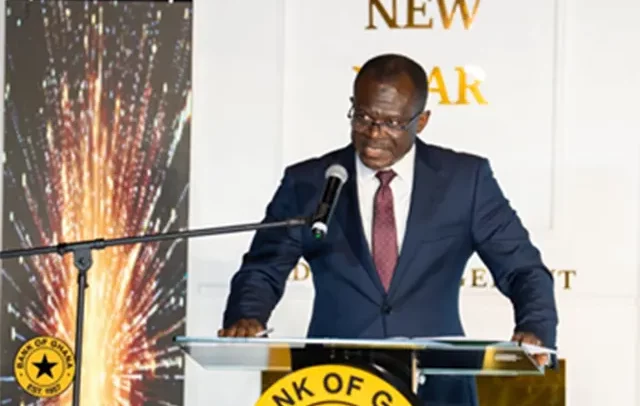
Dr. Zakari Mumuni
The First Deputy Governor of the Bank of Ghana (BoG), Dr. Zakari Mumuni, has cautioned that poorly reported economic issues by the media can create unnecessary panic in the foreign exchange market, even when underlying conditions remain stable.
Speaking at the Governor’s New Year media engagement at Bank Square in Accra recently, Dr. Mumuni explained that Ghana operates a managed floating exchange rate regime in which daily movements, small appreciations or depreciations, are normal and reflect routine market trading rather than economic distress.
He noted that when such movements are reported without proper explanation or context, they can trigger fear-driven behaviour, prompting individuals and businesses to seek to protect value, artificially increase demand for foreign currency, and ultimately heighten market volatility.
“In this sense, reporting itself becomes a market signal. Confidence in the cedi can weaken not because fundamentals have changed, but because sentiment has,” Dr. Mumuni said.
He added, “Responsible, measured reporting has the opposite effect; it reinforces calm, encourages rational behaviour, and allows markets to function more efficiently.”
He stressed that the media is not merely an observer of economic events but also a transmitter of confidence and a shaper of public sentiment, often becoming an unwitting participant in market dynamics.
“How the actions of the Bank of Ghana are reported. How they are explained, framed, and contextualized has real consequences for households, businesses, and investors,” he added.
Dr. Mumuni also underscored that currency stability is not an abstract macroeconomic concept but one with direct implications for the daily lives of Ghanaians.
According to him, stability enables businesses to price goods with confidence, allows investors to plan effectively, and assures workers that their earnings will not lose value overnight.
He further highlighted the unique role of central banks in national life, describing them as public institutions that act in the interest of citizens while remaining operationally independent from short-term political pressures.
He explained that the Bank of Ghana regulates banks, manages the national currency, provides banking services to government, and serves as custodian of financial stability, hence the need for responsible reporting on its activities.
Dr. Mumuni warned that sensationalism can amplify anxiety, while incomplete context can distort public understanding.
Conversely, he said balanced and informed reporting can stabilise expectations and strengthen confidence, noting that perception often precedes reality.
Touching on recent performance, the First Deputy Governor said the cedi ended 2025 significantly stronger, reflecting improved economic fundamentals, disciplined policy implementation, and growing confidence in the monetary framework.
He described the outcome as “not a victory for the central bank alone, but a shared national gain,” stressing that while instability harms everyone, stability benefits all.
Dr. Mumuni also called for greater context in reporting on central bank losses, explaining that such losses are not unique to Ghana and often arise when central banks take decisive actions in the public interest during periods of economic crisis.
“When this distinction is not clearly explained, public trust can be eroded. Yet trust is the very foundation upon which monetary policy rests,” he said.
“The thrust of policy must not be lost – inflation fell sharply, reserves were rebuilt, and the cedi strengthened. These are the outcomes that ultimately matter to citizens,” he noted.
By Ebenezer K. Amponsah