

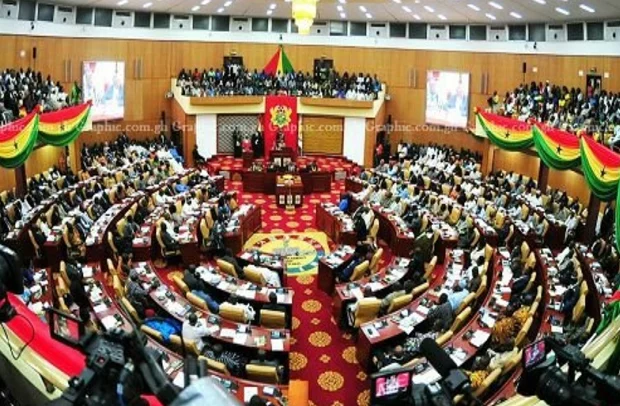
Parliament yesterday approved GH¢1.619 billion to finance its operations for the 2026 financial year, but the allocation has sparked sharp criticism from Members of Parliament (MPs), who insist the amount is grossly inadequate to support the Legislature’s expanding mandate.
The House had originally submitted a budget of GH¢4.6 billion, but this was slashed to GH¢1,619,643,682 by the Ministry of Finance, which cited tight fiscal conditions and limited budgetary space.
The reduction triggered widespread discontent among MPs during the debate on the report of the Committee on Parliamentary Affairs.
The committee itself concluded that the allocation was “woefully inadequate” and incapable of meeting Parliament’s needs for the year.
It warned that persistent underfunding was undermining the institution’s effectiveness, and therefore proposed the establishment of a dedicated fund for the Legislature.
Such a mechanism, the committee argued, would safeguard Parliament’s autonomy and ensure stable financing to support its constitutional duty of oversight over the Executive.
The committee also urged the Ministry of Finance to consider Parliament’s operational realities and increase its allocation during the mid-year budget review.
During the debate, MPs from both sides of the House voiced frustration about chronic resource constraints.
The New Patriotic Party (NPP) MP for Ofoase-Ayirebi, Kojo Oppong Nkrumah, argued that Parliament should be guaranteed a fixed share of national revenue in the same manner as statutory funds such as the GETFund and the National Health Insurance Fund.
He lamented that despite Parliament’s pivotal oversight role, its budget has for years fallen far short of what is required for effective work.
Mr. Oppong Nkrumah highlighted the lack of properly equipped constituency offices, forcing MPs to conduct meetings with constituents “in informal locations” that lack basic facilities such as ventilation systems and functional printers.
He also cited the deteriorating state of Job 600, describing the situation as inconsistent with the standards expected of a modern legislature.
He urged the Executive to prioritise the resourcing of Parliament to ensure effectiveness of the institution’s oversight mandate.
The NPP MP for Walewale, Dr. Abdul Kabiru Tiah Mahama, reinforced these concerns, warning that Parliament had for too long operated “at the mercy of the Executive,” receiving only less than 40 percent of the funds it requested.
He expressed disappointment that successive governments had witnessed Parliament’s struggles firsthand yet still failed to provide adequate resources.
Dr. Mahama also lamented the institution’s infrastructural limitations, noting that Parliament is not disability-friendly and lacks the modern amenities available in legislatures across Kenya and Nigeria, where he said MPs are better supported and resourced to carry out their duties.
On the Majority side, the National Democratic Congress (NDC) MP for Bolgatanga Central, Isaac Adongo, acknowledged the gravity of the resourcing challenges but argued that the problem cannot be solved within a single budget cycle.
He said the shortfalls were the result of systemic neglect over many years and urged MPs to adopt a long-term view.
Mr. Adongo expressed confidence that the Finance Minister, who himself is an MP, would progressively improve Parliament’s budget in the years ahead.
He stressed that while this year’s allocation is still inadequate, it represents a step toward reversing the trend of underfunding.
Responding to the concerns, the Deputy Minister for Finance and NDC MP for Asuogyaman, Thomas Nyarko Ampem, defended the GH¢1.6 billion allocation as fair and in line with the national economic situation.
He explained that all arms of government, including the Executive and Judiciary, had experienced similar cuts in view of the country’s constrained fiscal environment.
Mr. Ampem noted that Parliament actually recorded the highest percentage increase of any state institution (over 45 percent compared to its 2025 allocation), demonstrating the government’s willingness to support the House despite financial limitations.
He added that budget releases had improved markedly, with the full allocation for 2025 disbursed, a departure from previous years where funds were delayed or partially released.
The Deputy Minister encouraged MPs to utilise the available funds efficiently, and assured the House that the 2026 allocation would be released on schedule.
He maintained that the government remains committed to addressing the institutional challenges confronting Parliament and to strengthening its capacity to deliver on its constitutional responsibilities.
By Ernest Kofi Adu, Parliament House